
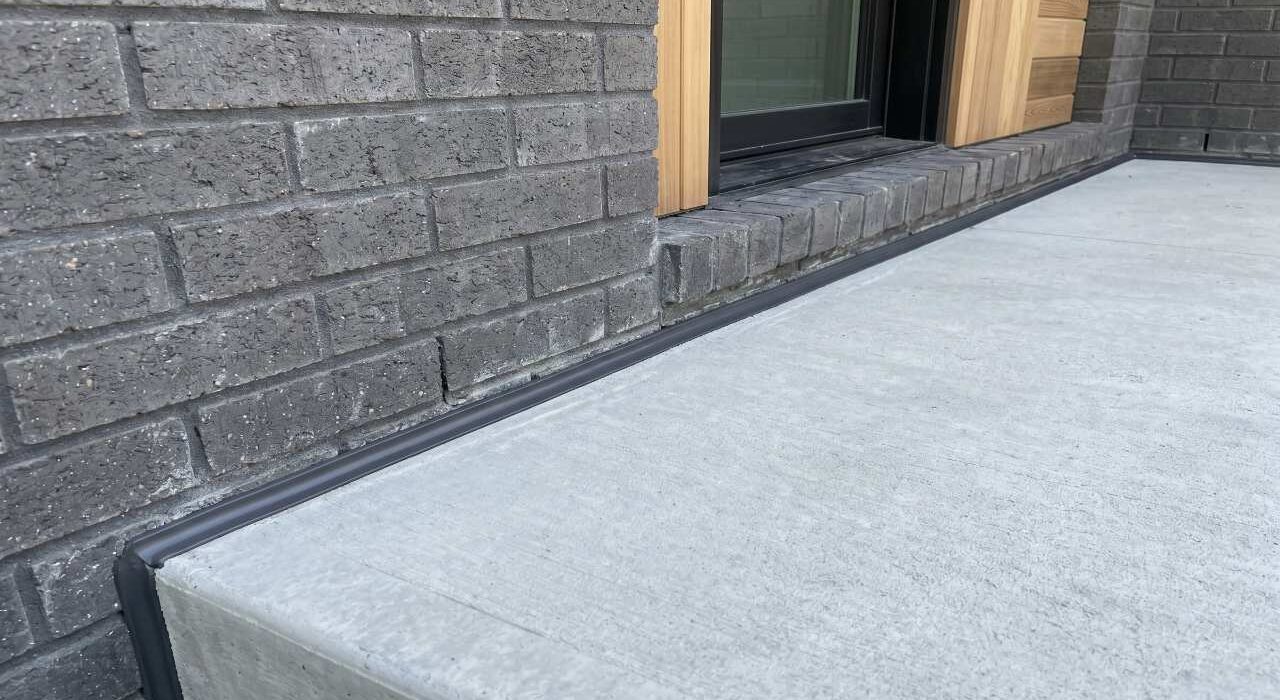
Walk up to the front entryway of your home in Oakville, Burlington, or Milton and look closely at the horizontal seam where your heavy concrete porch steps or backyard patio slabs meet the main brick facade. Managing this specific high-movement structural boundary relies on professional porch to house expansion joint caulking to shield your lower building envelope from severe sub-slab washout.
This structural transition line is the single most vulnerable and exposure-prone moisture point on your home’s lower exterior. When this horizontal expansion line dries out, splits apart, or settles unevenly, it forms a hidden entry track that lets heavy rainwater siphon directly past your masonry finishes and erode the sub-base below.
Most local property owners walk over this critical entrance threshold dozens of times a day without a second thought. However, the progressive structural sub-wall decay and porch sinking that follow when this massive concrete masonry joint is left open are happening relentlessly right underneath their feet.
Porch Entryway Physics: Why Differential Settling Tears Cheap Caulk
Clay brick masonry and poured concrete structural slabs behave in fundamentally opposing ways over their operational lifespans. Clay brick undergoes continuous, permanent moisture expansion, slowly and irreversibly swelling over decades as it absorbs atmospheric humidity.
Poured concrete structural slabs behave in the exact opposite manner, naturally shrinking as they cure and continuously contracting over their early years. At the same time, the massive concrete porch or patio slab settles downward under its own heavy weight as the underlying sub-base dirt consolidates.
These two heavy building materials are actively moving in conflicting directions simultaneously. The main brick wall expands outward and upward, while the adjacent concrete porch steps or patio slab shrinks and settles downward.
This opposing movement subjects the horizontal transition joint to intense multi-axis shear loading. The stress intensifies with every seasonal thermal expansion cycle, heavy rain event, and ongoing year of differential settling.
Adhering to the strict BIA technical guidelines for accommodating brickwork expansion defines the engineering baseline required to calculate these independent movement tolerances and prevent catastrophic masonry fractures. Following these industrial standards ensures your structural porch transitions remain fully protected against unshielded moisture tracking.
A rigid consumer-grade acrylic or latex caulk possesses absolutely zero structural capacity to survive this aggressive, multi-axis loading condition. The cheap retail compound rapidly tears cleanly through the center of the bead or releases adhesively from the non-porous concrete or brick faces.
Either failure mode produces the exact same destructive result: an open, gaping joint at the entry threshold with direct access to the structural ledger board and home framing right behind it. Water siphons straight through this split perimeter, pooling beneath your entryway and rotting out your interior door subfloors.
This entryway transition failure is directly linked to the vertical movement tracks running up the main facade above it. Our article on brick masonry expansion joint caulking covers the full structural physics of how clay brick movement generates these critical pressure-relief requirements across your entire exterior wall elevation.
The Entryway Nightmare: Porch Sinking and Sub-Slab Water Pooling
When a porch-to-house expansion joint fails, tracking water does not simply run down your brick face and safely disperse across the yard. Instead, it follows the failed joint inward, moving straight behind your brick veneer and pooling directly against the home’s structural framing lines and underlying concrete pad.
Entryway framing assemblies across Halton Region homes are subjected to relentless moisture accumulation whenever water traps against their exterior threshold face. The moisture presses inward through micro-fissures in the exterior cladding, through mortar tracks below the main door sill, and through any timber framing joint or sub-floor penetration in the assembly.
The result is aggressive sub-threshold moisture intrusion that appears as rot along the ledger board, damp insulation in your entryway walls, and buckling interior hardwood flooring inside your front foyer. Left unsealed, this entry-level water logging will permanently rot out your finished floor joists and spark widespread structural timber breakdown.
The sub-slab consequence is equally damaging to your home’s exterior property value and structural layout. Water that flows behind the failed transition joint and under the edge of the concrete slab begins aggressively eroding the compacted granular sub-base that supports your porch or patio from below.
This erosion creates hollow, hidden voids beneath the slab edge, completely removing the structural bearing support for the concrete closest to your house walls. Over multiple freeze-thaw seasons, the unsupported slab begins to tilt inward toward the main building facade, directing surface storm water even more aggressively against your brickwork.
Eventually, this unsupported edge cracks cleanly under its own massive weight or under the foot traffic load of anyone stepping onto the front porch entryway. Reconstructing a sunken concrete porch structure in the Halton market is a disruptive, five-figure project, whereas properly resealing the dynamic transition joint that caused the failure is a fraction of the cost.
The identical sub-base erosion mechanics that destroy concrete porch transitions also operate across your wider hardscape surfaces. Our article on driveway patio concrete control joint sealing covers how open horizontal pavement joints accelerate sub-base washout across your entire hardscape perimeter.
The identical sub-base erosion mechanics that affect heavy front entrance stairs also operate across broad, grade-level ground perimeters. Homeowners looking to insulate long walkways or residential pavement lines can review our core guide on Oakville foundation caulking to eliminate deep basement moisture siphoning.
Our Specialized 4-Phase Porch and Patio Joint Restoration Workflow
A surface patch over a grade-level entryway transition joint that has been open through multiple freeze-thaw cycles is not a repair. The joint channel at this location accumulates road salt, carbonation deposits, biological spore material, and compacted organic debris that prevents any new sealant from bonding.
New material applied over contaminated substrate bonds strictly to the debris layer rather than to the concrete or brick faces. A durable transition seal demands a pristine breakout down to bare concrete on the slab face and bare brick on the masonry face.
Phase 1: Deep Extraction of Traffic-Fatigued Porch Seams
All existing sealant, degraded foam backer, and compacted debris are removed completely using oscillating tools, hook scrapers, and narrow rotary cutters. Because of its entryway location, this transition joint is exposed to more physical compression and dirt compaction than any other joint on the house.
This joint is exposed to intense, direct physical foot strikes and heavy structural vibration every time someone steps onto your front entryway. This constant mechanical impact packs dirt and grit deep into the seam, requiring localized detail scraping tools to clear the joint down to raw substrate.
Phase 2: Stripping Entryway Carbon, Ground Salt, and Biological Spores
After mechanical extraction, both joint faces are cleaned with specialized solvents to strip away residual salt deposits, carbonation film, atmospheric soot, and biological root systems. Winter road salt treatment from clearing snow off steps is a severe architectural threat to grade-level joints across the Halton Region.
Sodium chloride residue chemically destroys a fresh sealant’s adhesion chemistry on both concrete and brick if it is not fully neutralized first. All moss, mold spores, and lichen root systems must be completely eradicated so the new polymer does not debond from below during curing.
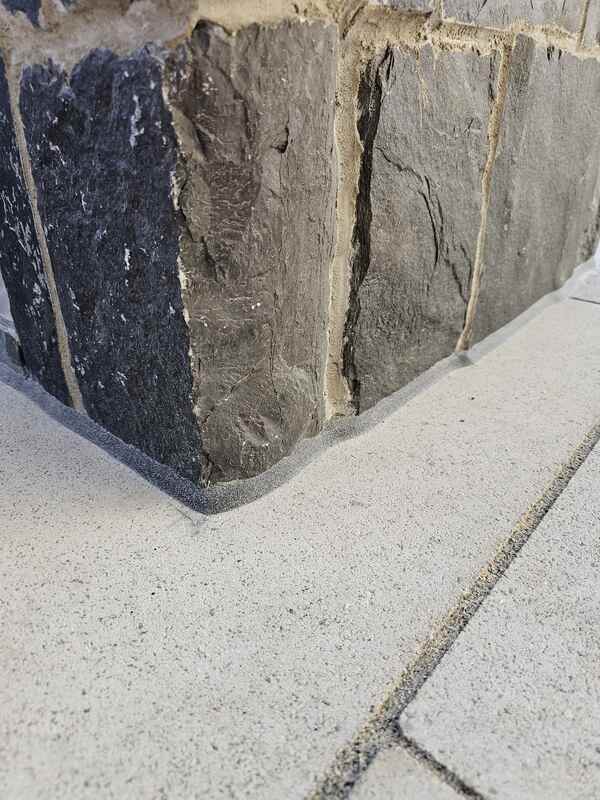
Phase 3: Engineering Deep Expansion Cavities with High-Density Foam Cushions
Where the transition gap between the concrete porch slab and brick wall is wide, a high-density closed-cell backer rod is installed. Our installation crews enforce a strict 1:1 width-to-depth structural ratio across all ground-level entry boundaries to handle continuous settlement and intense physical foot strikes.
For a standard 20mm wide horizontal porch joint, the center polymer ribbon is Hand-tooled to an exact thickness of 20mm over the foam rope. Creating a flexible, square hourglass cross-section distributes dynamic structural stress evenly across the joint, completely preventing the sealant from tearing down the center under intense soil movement.
Our team intentionally over-sizes the backing foam diameter to maintain a tight compression fit even if the concrete slab continues to slowly settle and pull away from the house over the coming decade. As detailed in our comprehensive guide to professional joint preparation, installing this flexible foam layer is structurally essential to achieve permanent elongation performance under cyclic loads.
Phase 4: Tooling Load-Bearing, Elastic Polyurethane Porch Barriers
Our installation crew injects a specified traffic-rated, heavy-bodied polymer deep into the prepped concrete joint using specialized high-pressure delivery systems. The freshly applied polymer track is hand-pressed immediately into a smooth concave profile with an architectural tooling trowel.
This mechanical compression drives the thick sealant deep into the microscopic pores of the stone masonry and concrete steps. The tooled downward slope forms a continuous watershed barrier that forces heavy storm sheets to slide off the porch instead of tracking backward into your front door threshold plate.
The specialized, heavy-gauge polyurethanes we deploy to seal entryways and porches are formulated to withstand relentless physical friction and impact loading without tearing loose.
These commercial elastomeric compounds are engineered to meet strict modern building envelope durability rules, aligning perfectly with the structural material performance guidelines published in the official Codes Canada publications directory.
This superior structural grading enables the cured rubberized bead to expand and compress seamlessly during intense Ontario freeze-thaw drops while surviving decades of heavy foot traffic.
Tooling this flexible compound along your high-stress concrete transitions forms a permanent, shock-absorbing barrier that easily handles the heaviest movement loads streaming across your grade steps.
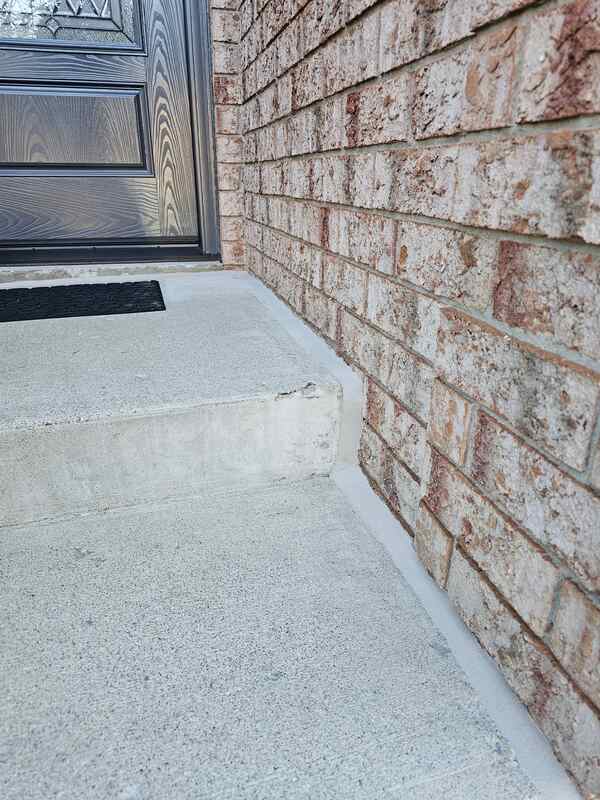
5 Signs Your Porch or Patio Expansion Joint Needs Immediate Attention
A grade-level inspection of every concrete porch step and backyard patio transition on your property identifies every active failure before the consequences ruin your entryway layout. Spotting these structural red flags early allows you to address the problem before it compromises your home’s lower building envelope.
Left unsealed, these expanding gaps also invite wood-boring pests and burrowing rodents to invade your home’s framing line. To discover how grade-level gaps turn into structural pest highways, read our definitive guide on pest prevention window caulking to learn how to insulate your property boundaries.
1. Visibly Open, Empty, or Debris-Filled Entryway Cavities
A horizontal joint that is visibly open, empty, or filled only with compacted organic debris has no active weatherproofing function. This compromised seam operates as a literal gutter, directing every single rain event and pooling snow-melt straight into your front door ledger frame line.
2. Cracked Beads and Adhesive Transition Release
Sealant that has cracked cleanly through its center or pulled away from either the concrete steps or brick face is exhibiting textbook multi-axis shear failure. This delaminated rubber compound is no longer providing moisture protection or air sealing, allowing cold floor drafts to chill your entryway flooring.
3. Localized Efflorescence Ringing and Slipped Brick Mortar
White, powdery mineral efflorescence forming on brick faces directly adjacent to an outdoor porch confirms that water is breaching your lower building envelope. By the time these white stains show up along the entryway track, the underlying wooden framing plate has likely been taking moisture for multiple seasons.
4. Sinking, Tilting, or Uneven Entry Step Concrete Slabs
Concrete porch steps or patio panels that settle lower at the edge closest to the brick wall than at the outer edge indicate active sub-base erosion. This inward tilting proves the joint failure has been neglected long enough for tracking rainwater to wash away the crucial supporting granular material beneath the slab.
5. Weather-Baked Original Builder Seals Exceeding 10 Years of Age
Any entry threshold transition joint that was sealed during original construction and has never been professionally replaced is operating well beyond its service life. Even if the old compound appears somewhat intact from a standing position, its deep molecular adhesion against the porous masonry has completely vanished.
Seal Your Entry Threshold Before Your Subfloor Pays the Price
A failed joint immediately begins directing heavy rainwater toward your internal framing lines and door header plates with every single storm event. Taking the time to properly insulate this high-movement structural boundary eliminates progressive subfloor timber rot before the winter freeze arrives.
Contact Oleg at Proper Caulking to book an expert on-site structural porch joint assessment for your Oakville, Burlington, or Milton property today. We meticulously inspect every concrete porch step transition, backyard patio base, entryway threshold junction, and multi-material perimeter on your exterior layout.
Our professional field crew gives you a completely transparent assessment of exactly what framing and floor components are currently at risk. We provide a detailed, honest project estimate backed entirely by our industry-leading 10-year workmanship warranty.
If you want to check out how our field crews seal tricky masonry transitions, concrete steps, or horizontal structural ledges, take a look at our full menu of exterior sealing services built to eliminate drafts throughout the Halton region. Booking your evaluation early in the spring ensures your protective silicone installation is complete and fully cured before peak seasonal weather cycles arrive.
Protect Your Entryway and Subfloors From Shifting Porches and Slabs
Don’t let degraded porch-to-house expansion joints rot out your subfoyer wood framing, warp your entryway hardwood floors, or wash out your concrete step sub-base. Contact us for a specialized, professional structural porch joint assessment today.
Proper Caulking – Oakville, Burlington & Milton, Ontario