
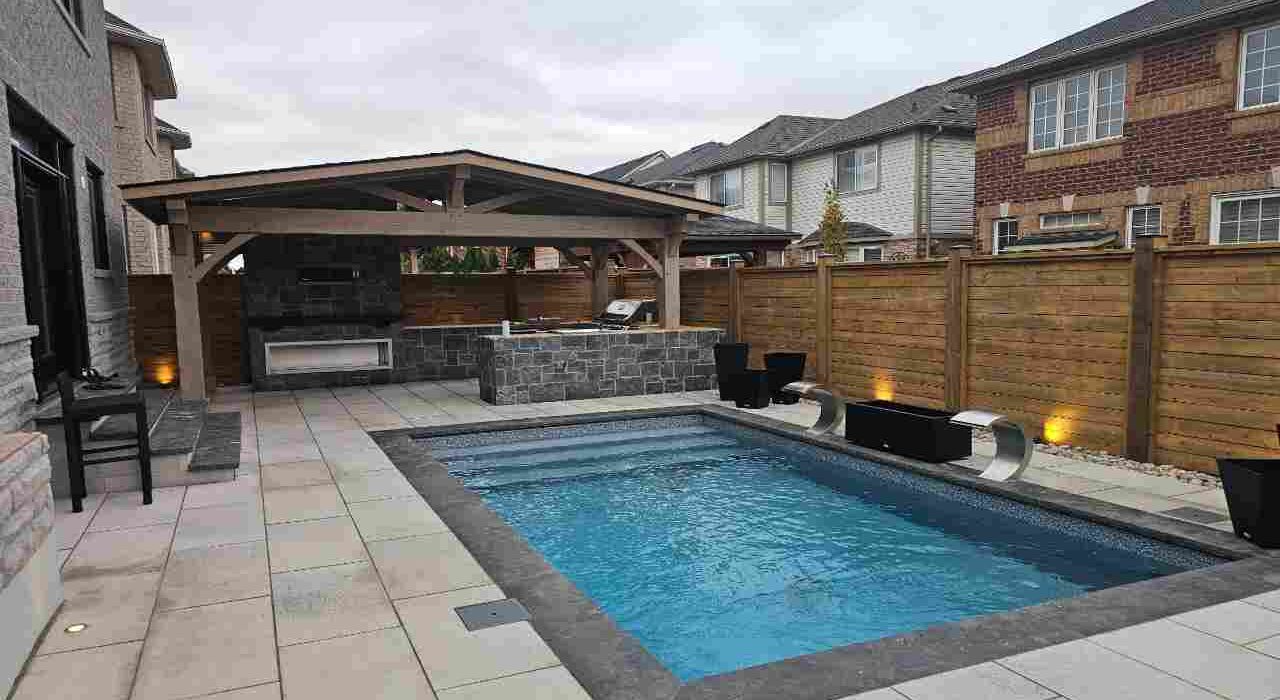
Late spring across Southeast Oakville, Bronte, Roseland, and Tyandaga means pool opening season. While focus shifts above the waterline, the horizontal expansion seam where stone coping meets the concrete deck is routinely ignored. This critical gap is exactly where professional pool deck caulking protects your investment from deteriorating.
This boundary isolates two surfaces moving at different thermal rates. The stone coping is bonded to the pool’s concrete bond beam, while the surrounding deck sits on a separate, compacted aggregate sub-base. They are intentionally separated to allow independent movement, relying entirely on the joint sealant to block water, chlorine, and silt.
When this sealant fails, water triggers an invisible subsurface erosion cycle beneath your patio. The destruction begins underground, washing out the aggregate base until the concrete slabs crack and sink. By the time damage is visible, repairs cost thousands in emergency concrete or masonry reconstruction.
⏱️ Pool Coping Standard
Sealing horizontal pool coping joints requires high-performance, chemical-resistant self-leveling polyurethanes or hybrid silicones (like Sikaflex-2c SL or DOWSIL 790) that pass the strict ASTM C920 standard to withstand continuous chlorine exposure and intense UV rays. To handle aggressive independent movement between the concrete deck and the pool bond beam, installers must wedge closed-cell backer rods to enforce a strict 2:1 width-to-depth joint geometry ratio. Completely stripping out old chlorine crusts and neutralizing the concrete face is mandatory to prevent early adhesive face peeling and sub-base gravel washout.
The Physics of Deck Erosion and Shifting Coping Stones
The pool environment is one of the most demanding conditions a horizontal expansion joint can face. The combination of continuous water exposure, chlorinated runoff, thermal movement, and freeze-thaw cycling creates a failure environment that degrades inferior sealants rapidly and punishes an open joint aggressively.
Every splash from the pool, every summer downpour, and every backwash cycle adds water to the deck surface. Water that reaches a failed or open joint at the coping line does not stay on the surface.
It follows the path of least resistance straight down through the gap, into the granular bedding sand and compacted sub-base beneath the concrete deck panels and behind the coping stones. This is the beginning of the sub-base erosion cycle, and it progresses faster than most homeowners expect.
Repeated water infiltration washes the fine particles of bedding sand and compacted granular material out from beneath the concrete panels in a process directly analogous to the foundation washout failures described in our article on failed concrete seals and grade-level joints.
As the sub-base erodes, concrete panels lose their support at the edges closest to the pool. They begin to tilt inward, creating lips and level changes at joints that were previously flush.
These become tripping hazards at the exact location where bare feet and wet surfaces create the highest slip-and-fall risk in any residential property. In advanced cases, unsupported panels crack through their full thickness and require mudjacking or full replacement to stabilize.
The coping stones face a separate but equally damaging failure path. Water that penetrates behind the coping bonds to the pool’s concrete bond beam. When temperatures drop below freezing, that trapped water expands by approximately nine percent as it converts to ice.
The ice crystals push against the back face of the coping stone with force that exceeds the adhesive bond between the stone and the beam. The coping stone delaminates and pops off the beam in sections, often taking pieces of the bond beam surface with it.
Natural stone coping from premium installations in Southeast Oakville or Tyandaga is expensive to source and difficult to match once sections have been damaged or lost.
For a comparison of how horizontal pool deck joint movement differs from the vertical structural movements addressed in masonry expansion joint design and vertical wall seam sealing on brick-clad homes, our article on exterior masonry joint engineering covers the contrasting physics of each system in detail.
For authoritative guidance on concrete slab joint design and the engineering standards behind sub-base protection, the official American Concrete Institute (ACI) Expansion Joint Design Guidelines provide the technical baseline that professional contractors work from in this high-exposure environment.
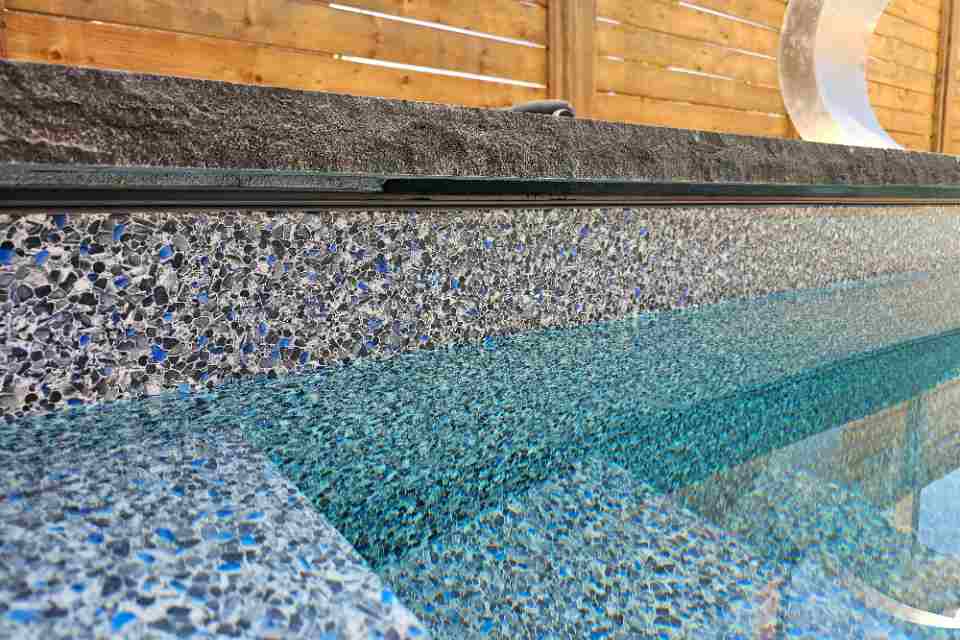
The Chemical Challenge: Why Retail Products Fail in Pool Environments
Pool decks are hostile environments for sealant chemistry. The combination of chlorine-saturated water, UV radiation at full outdoor exposure, sustained wet-dry cycling, foot traffic, and the mechanical movement of the joint under thermal load degrades standard retail sealants far faster than the same products would fail in a sheltered or indoor application.
Standard retail polyurethane caulks are the most commonly misapplied product in pool coping joints. They bond adequately in dry conditions at the time of application and look correct immediately after installation.
The chemical exposure begins as soon as the pool is filled and active. Chlorinated water that contacts the sealant surface initiates a degradation reaction in standard polyurethane formulations. The compound softens progressively, loses its cohesive strength, and begins to lift from the substrate.
Within a season or two, the bead has become a sticky, discoloured, partially debonded strip that provides no meaningful waterproofing and traps debris against the joint faces. Retail acrylic latex caulks fail even more quickly in pool environments.
Their water-based formulation swells under constant moisture exposure, accelerating adhesion loss at both substrate faces. UV exposure on an open pool deck bleaches and embrittles acrylic compounds rapidly, producing visible surface cracking well before the end of the first season.
The correct material category for a pool coping joint is a chemical-resistant sealant formulated specifically for continuous water exposure and UV resistance. Advanced multi-component self-leveling sealants are well-suited for wide horizontal pool deck joints where a level, poured application is practical.
For the coping-to-deck interface, high-performance neutral-cure silicones provide the chemical resistance, elongation capability, and UV stability that the environment demands without the corrosive byproducts that acetoxy-cure retail silicones release during curing.
Critical Failure Signs in Pool Deck Expansion Joints
A careful inspection of your pool deck perimeter at the start of the season takes fifteen minutes and tells you everything you need to know about the condition of your coping joint sealant. The following are the specific indicators that the existing sealant is no longer providing structural protection.
Deep Unsealed Voids and Separated Coping Seams
An open gap between the coping stone and the concrete deck with no sealant material present is the most straightforward failure condition.
Whether the original sealant was never installed, has fully debonded and fallen out, or was removed without replacement, the result is the same: an unobstructed channel for water and debris to enter the sub-base with every water event.
Soil, sand, and organic material accumulating in the void confirm that water infiltration has been active for multiple seasons.
Lengthwise Adhesive Splitting Down the Centre of the Joint
A sealant bead that appears intact at the substrate faces but shows a crack or split running along the centre of its length is exhibiting three-sided adhesion failure.
This occurs when sealant was applied without adequate depth control, bonded to the back of the joint cavity as well as both faces, and tore through the middle as the joint moved.
The joint is effectively open despite the visual presence of sealant material. Water passes through the split freely.
Sticky, Gummy, or Discoloured Caulking Degradation
Sealant that feels tacky or soft when pressed, has turned yellow or brown from its original colour, or smears rather than holding its form under light pressure has undergone chemical degradation from pool water exposure.
It has lost its cohesive integrity and its adhesive bond to the substrate surfaces. It is not sealing anything. It is simply occupying the joint space.
Hollow-Sounding Coping Stones and Sinking Concrete Panels
Tap coping stones firmly along their length with a knuckle or a rubber mallet. A properly bedded stone returns a solid, dense sound. A stone that has lost its bedding due to water infiltration behind the bond beam returns a hollow resonance.
Hollow-sounding coping stones indicate that sub-base material has washed out behind or beneath the stone and that freeze-thaw delamination risk is active.
Similarly, concrete deck panels that are visibly lower at the pool edge than at the outer edge have begun the settling process driven by sub-base erosion.
Weed Growth and Silt Pushing Up Through the Joint Line
Organic material, fine silt, and weed root systems emerging from a pool coping joint confirm that the sub-base below is saturated with organic-rich soil and that water has been flowing through the joint for long enough to transport biological material upward from below.
This level of joint deterioration indicates that the sub-base has been compromised and that a professional assessment of the surrounding slab condition is warranted alongside the resealing work.
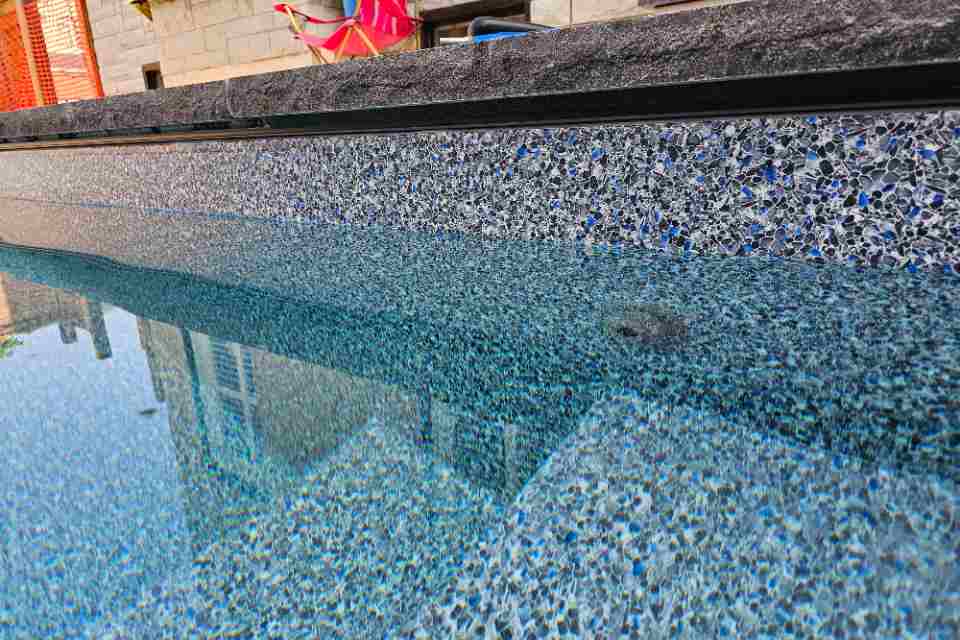
The Meticulous Restoration Workflow for Backyard Joints
A surface patch applied over a chemically degraded or partially debonded pool coping sealant will not hold. The contamination layer between the old sealant residue and the substrate faces prevents the new material from forming a clean adhesive bond.
The patch bonds to the surface of the old compound rather than to the stone and concrete directly, and it debonds along that interface under the first thermal movement cycle or water exposure event.
The only approach that produces a durable result in a pool environment is complete mechanical extraction of all existing sealant and contamination, followed by correct substrate preparation and the application of a properly specified chemical-resistant sealant to clean, bare surfaces.
Phase 1: Deliberate Extraction of Weathered Sealants and Coping Contamination
All existing sealant, foam backer, debris, and biological material in the joint is removed completely using oscillating tools, hook scrapers, and detail blades.
The target is raw concrete on the deck face and raw stone or concrete on the coping face, with zero residual adhesive, chlorine deposits, or soil contamination at either bonding surface.
In pool coping joints that have accumulated seasons of degraded material, this extraction process is far more involved than a standard window joint. It requires highly careful, deliberate tool selection to avoid chipping or marring the sensitive stone coping edges.
Phase 2: Chemical Stripping and Substrate Chlorine Neutralization
After mechanical extraction, the joint faces are cleaned with specialized solvents to remove stubborn adhesive residue. They are then thoroughly treated to neutralize any crusty chlorine or saltwater compound deposits embedded on the concrete surface.
Chlorine residue on a concrete substrate will aggressively interfere with sealant adhesion chemistry and trigger rapid delamination. This preparation step is specific to harsh pool environments and is never a standard element of a residential window or foundation joint repair.
Phase 3: Installing Non-Absorbent Backing Foam for Saturated Pool Environments
Wide or deep pool coping joints require a backer rod installed at the correct depth before sealant application. Controlling the depth-to-width ratio of the sealant cross-section is what gives the finished bead its elite elongation capability under extreme joint movement.
Our guide to professional joint preparation covers the full structural rationale for installing a foam backer rod in any deep horizontal joint, and why the hourglass geometry it creates is the difference between a sealant that stretches correctly and one that tears.
In pool environments, the backer rod material must be a closed-cell formulation that does not absorb water. Open-cell foam will saturate in a pool deck application and transfer moisture behind the sealant face, undermining the waterproofing function of the finished joint.
Phase 4: Applying Chemical-Resistant Self-Leveling Polyurethane Barriers
Our installation crew injects the specified chemical-resistant compound into the prepped joint track using advanced equipment that maintains uniform bead volume throughout the full perimeter. In flat horizontal layouts, this industrial self-leveling material naturally flows to a smooth, uniform finish without requiring any manual tooling.
Our technical crews completely prevent joint softening and bubbling from pool chemicals by injecting elite, trade-grade self-leveling polyurethanes or low-modulus silicones like Sikaflex-2c SL or DOWSIL 790 Commercial Sealant. These heavy-duty architectural polymers deliver the precise chlorine immunity, extreme elongation thresholds, and UV stability that a standard retail caulking line can never provide.
However, along pool deck perimeter lines featuring vertical or angled masonry faces near the stone coping edges, the freshly applied bead is instantly hand-tooled into a smooth concave profile. This essential mechanical compression forces the compound into the microscopic pores of the stone, ensuring it sheds water cleanly toward your deck surface rather than pooling at the interface.
The heavy-duty, climate-matched construction compounds deployed by our team are manufactured to withstand severe environmental loading. These advanced structural polymers feature dynamic expansion thresholds reaching up to 50 percent or more, satisfying every strict engineering metric established within the global ASTM C920 standard specifications.
This elastomeric threshold enables the finalized weatherbarrier to expand and compress smoothly through intense seasonal freeze-thaw shifts. It forms a highly flexible, shock-absorbing barrier that safely prevents the cured compound from tearing away or unzipping from your moving concrete slabs or natural stone coping substrates.
Tooling this flexible compound along your high-stress concrete transitions forms a permanent, shock-absorbing barrier that easily handles the heaviest water loads streaming down your exterior facade.
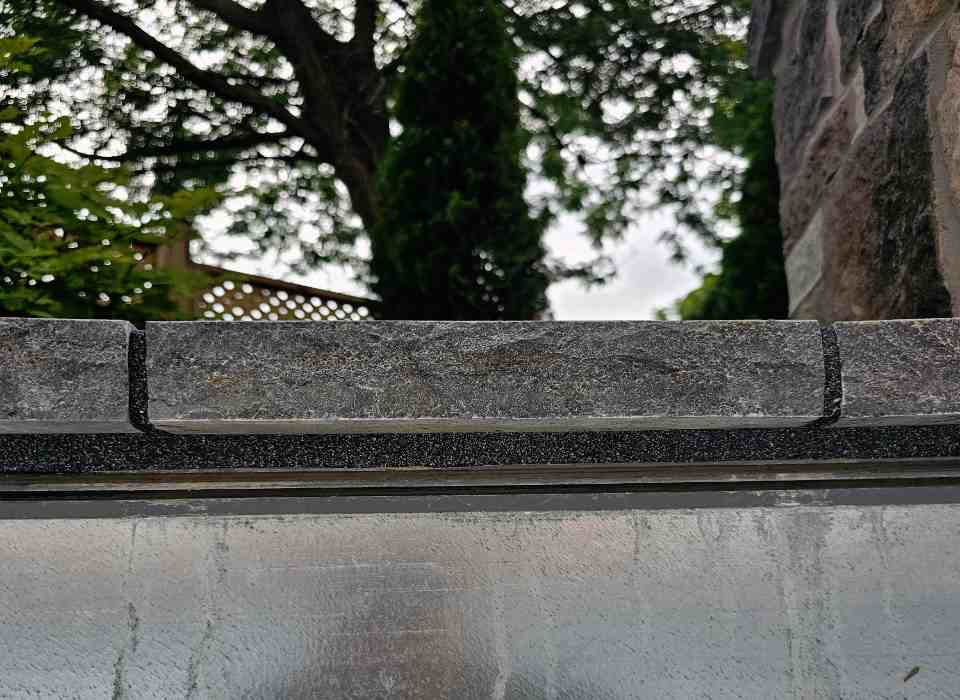
Protect Your Pool Investment Before Summer Arrives
A properly sealed pool coping joint costs a fraction of the structural remediation it prevents. Sunken concrete panels require expensive mudjacking or full slab replacement.
Delaminated coping stones require specialized bond beam repair and tedious stone resetting. This often involves sourcing matched material that is rarely available in the exact original specification.
Sub-base restoration under a pool deck involves intense excavation, recompaction, and complete slab reinstallation. Any of these severe outcomes, triggered by a failed expansion joint that could have been easily resealed at the start of the season, represents thousands of dollars of entirely avoidable expenditure.
The joint is incredibly small. The financial and structural consequences of ignoring it are not.
Contact Oleg at Proper Caulking to book an expert on-site pool deck visual joint assessment for your Oakville or Burlington property today. We inspect the full coping perimeter, the deck panel joints, and the surrounding grade-level transitions across your backyard hardscape.
Our team gives you a completely transparent assessment of what is at risk and provides an honest estimate backed entirely by our industry-leading 10-year workmanship warranty. Booking early in the season ensures your protective polyurethane installation is complete and fully cured before peak pool use begins.
To evaluate our extensive menu of architectural building envelope protections, you can examine our main service index to analyze our full range of professional weatherproofing solutions.
Our regional trade specialists install high-movement, commercial-grade exterior polymers engineered explicitly to seal deep moisture migration paths and permanently block structural draft points throughout the Halton community.
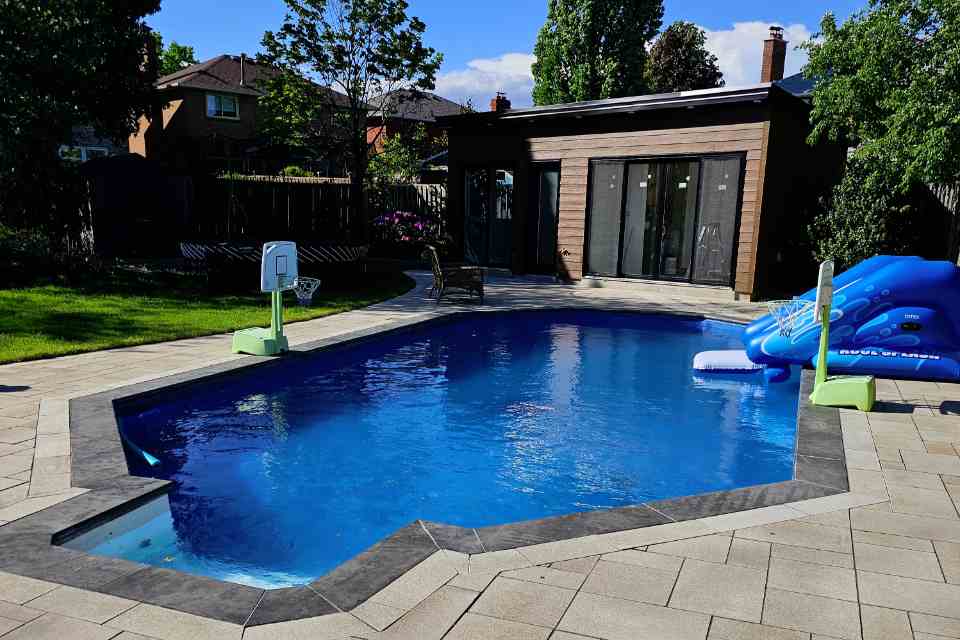
Protect Your Pool Deck From Costly Sub-Base Washouts
Don’t let failed pool expansion joints shift your stone coping or sink your concrete slabs. Contact us for a specialized, zero-obligation backyard joint audit today.
Proper Caulking – Oakville & Burlington, Ontario