
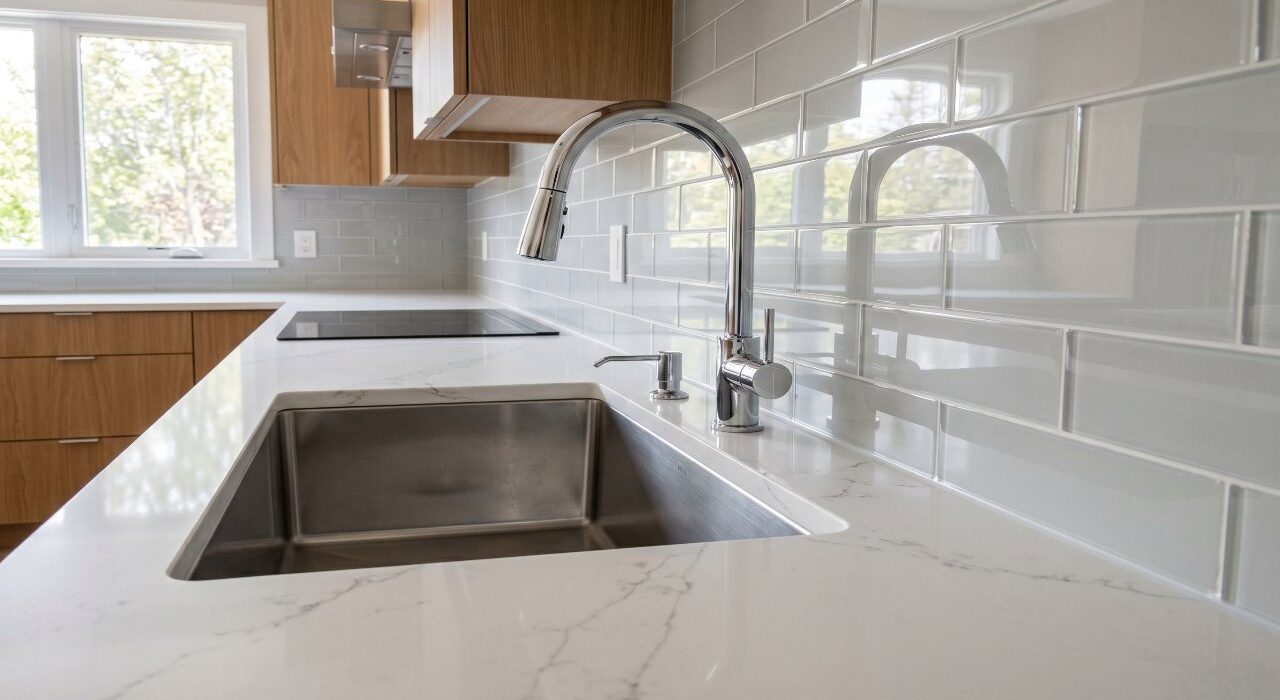
Interior silicone caulking is the invisible moisture barrier protecting your quartz countertops, undermount sinks, custom backsplashes, and glass shower enclosures from hidden water damage. When that seal fails, the destruction begins inside the wall cavity and subfloor before you ever see a single stain.
Oleg, owner of Proper Caulking, has spent years protecting luxury residential interiors across Burlington, Oakville and Milton. Cheap retail latex caulks fail within one heating season, while commercial-grade sanitary polymers maintain a watertight, mould-resistant bond for a decade or more.
Material Science: Anti-Microbial vs. Hardware Store Latex
Retail acrylic latex caulks are water-based compounds designed strictly for painted baseboards, not wet sanitary environments. Inside a kitchen or bathroom, they absorb moisture, lose their plasticizers, and begin to shrink and yellow within twelve months of application.
As they shrink, micro-gaps open between the caulk bead and the tile or stone face. These separations trap moisture, soap scum, and organic residue in a sealed, humid, dark channel.
This trapped condensation creates the exact environment that toxic black mould requires to establish and spread. The mould does not grow on the surface of the sealant; it grows behind it, completely invisible until it has colonized a significant area.
Premium 100% neutral-cure sanitary silicones solve this moisture trap at the chemistry level. These advanced architectural compounds contain active anti-microbial fungicidal additives that inhibit mildew growth at the molecular level.
Their neutral-cure chemistry releases non-corrosive byproducts during curing, allowing them to bond to polished stone, glazed tile, porcelain, and coated metals without etching or staining delicate luxury surfaces.
For deep technical specifications on these industrial movement standards, you can audit the external ASTM C920 standard specifications directory to see how commercial polymers maintain their rating.
They also maintain flexible molecular adhesion through years of thermal cycling, heavy water exposure, and the daily mechanical loading that undermount sinks and shower enclosures generate. The result is a sealant that performs chemically and mechanically in the wet interior environment where retail products fail within a year.
Our diagnostic guide on why exterior caulking cracks breaks down similar molecular failures caused by low-elongation store-bought compounds exposed to structural tension.
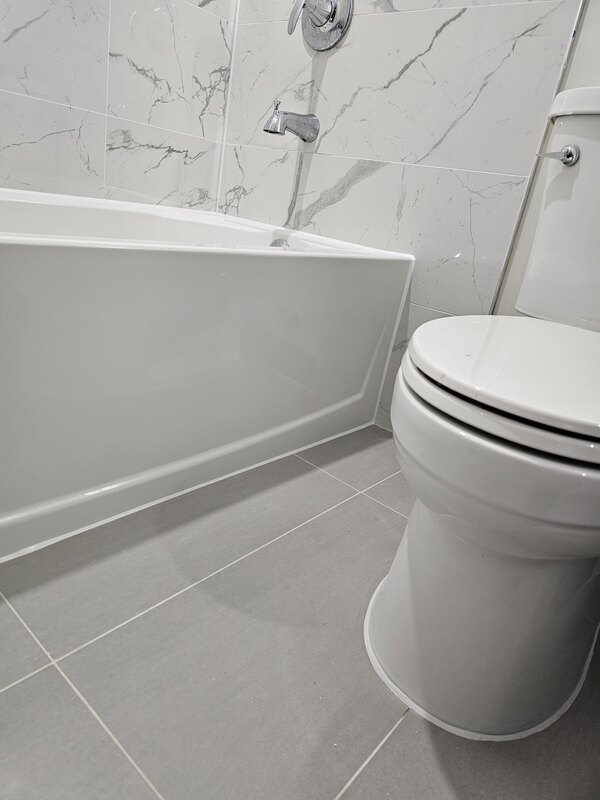
Our Specialized 4-Phase Sanitary Restoration Workflow
Smearing fresh silicone directly over an existing moldy or degraded bead is the single most common and costly interior caulking mistake. New silicone cannot bond to old silicone, to sticky latex residue, or to a contaminated substrate surface.
The new bead peels away within weeks because it was never actually bonded to the substrate in the first place. It simply attached to the failure layer beneath it. A lasting sanitary seal requires starting from a bare, chemically clean substrate on every bonding face.
Phase 1: Precision Extraction of Degraded Compounds
Our field crew completely strips away every single trace of the existing sealant using detail scrapers, oscillating tools with narrow blades, and utility knives appropriate to the joint geometry.
The extraction process is complete only when bare stone, bare tile, bare porcelain, or bare coated metal is exposed on both joint faces. We verify that absolutely no old latex, silicone residue, or hidden adhesive film remains anywhere in the channel.
Phase 2: Chemical Sanitization and Surface Neutralization
Following complete mechanical extraction, every raw bonding surface is deeply scrubbed with specialized, interior-safe solvents. This chemical wash removes soap scum film, grease residue, hard water mineral deposits, and any mold spore colonies that have established in the joint channel.
The surface must be chemically neutral and free of any release compound before new sealant is applied, because contamination at the molecular level will produce instant adhesion failure.
Phase 3: Seating Micro-Backing Cushions in Deep Expansion Gaps
Deep interior joints require a closed-cell micro-foam backing strip installed at the correct depth before any sealant application. This depth control is critical in the gap between an undermount sink rim and a quartz slab, or the expansion seam at the base of a custom stone shower curb.
As outlined in our guide to professional joint preparation, controlling material depth is mandatory to prevent your weatherseal from tearing. This foundation strip creates a flexible two-point adhesion geometry that allows the sealant to flex with thermal and settlement movements without tearing through the bead center.
Phase 4: Tooling Seamless, Water-Shedding Sanitary Profiles
Our technical crew injects specified premium sanitary silicone into every prepared joint using professional-grade applicators to deliver consistent bead volume.
Each bead is immediately hand-compressed and drawn to a mathematically straight, smooth concave profile with a dedicated tooling tool. This profile prevents standing water from pooling along the tile seam and presents a continuous, uninterrupted moisture barrier across the full joint run.
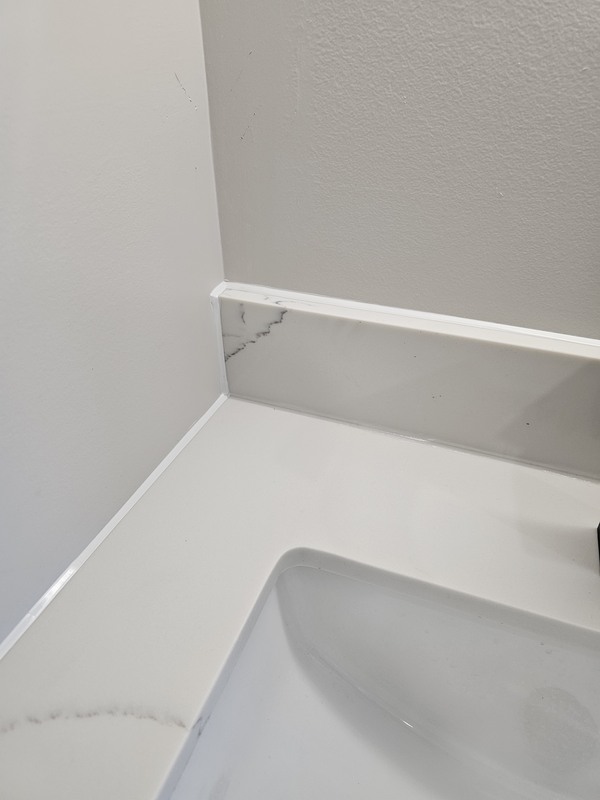
5 Red Flags That Your Interior Seals Have Failed
A close inspection of every wet-area joint in your kitchen and bathroom takes less than ten minutes and identifies active material breakdowns before moisture reaches the underlying wall framing. Spotting these subtle visual signs early allows you to intercept internal leaks before hidden structural decay forces expensive demolition work.
1. Black or Dark Grey Spots Behind the Bead
Active mould growth behind the sealant line means the existing compound has completely lost substrate adhesion and is no longer a moisture barrier. The hidden mould is actively feeding on organic residues and standing water that has tracked behind the bead.
2. Edges Unzipping or Peeling Away From Tile or Sink Rims
This total adhesion failure at one or both faces of the bead means the structural joint is completely wide open along its linear length. Water enters freely behind your finishes at every shower cycle, dishwashing task, or splash event.
3. Material Turning Hard, Chalky, or Flaking When Wiped
Cheap latex that has hardened and lost its elasticity is completely incapable of flexing with the surrounding home components. It will continue to crack, fracture, and separate further with every ambient thermal change in the room.
4. Sealant Pulling Apart Cleanly Down the Middle
A sharp split running along the center of the bead confirms a highly destructive three-sided adhesion failure occurred. The compound mistakenly bonded to the back wall of the joint cavity and tore under movement rather than stretching at the side adhesion faces.
5. Discoloration or Yellowing Around High-Heat Zones
Silicone or latex yellowing adjacent to cooktops, backsplash lighting, or steam-generating shower fixtures has undergone intense heat-accelerated material degradation. This scorched compound has officially lost both its active anti-microbial properties and its critical adhesive bonding chemistry.
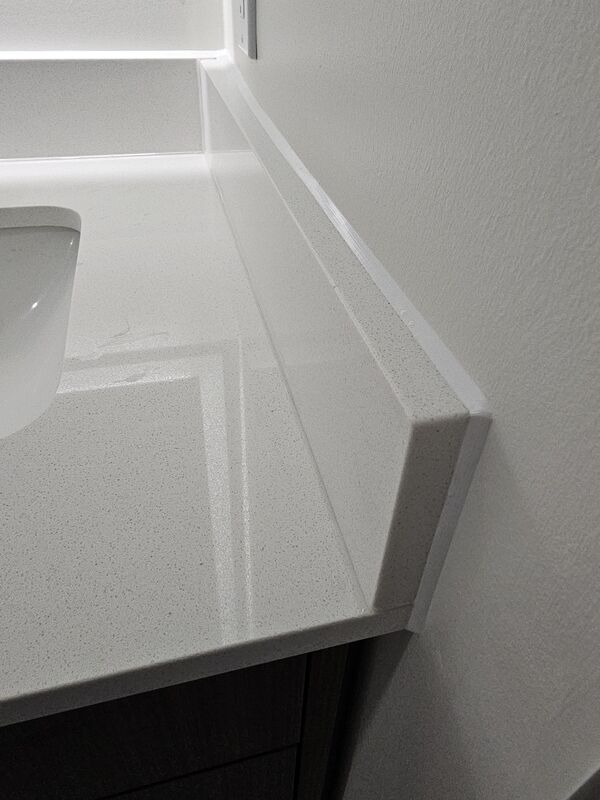
Secure Your Luxury Renovations Before Hidden Mildew Spreads
An open or failing interior joint in a kitchen or bathroom allows moisture to reach wood substrate, cabinet framing, and subfloor materials that are not rated for sustained water contact. Tracing and repairing under-cabinet rot or subfloor mould after the fact costs thousands of dollars more than a proactive sanitary seal applied before the damage begins.
Contact Oleg at Proper Caulking for a transparent, zero-obligation on-site interior joint analysis in Oakville, Burlington, or Milton. Every premium application is backed by a rock-solid 10-year workmanship warranty against material peeling. Visit the contact or services menu today to book your evaluation.
Protect Your Luxury Kitchen and Bathroom Renovations
Don’t let failed stone joints, moldy latex caulk, or leaking undermount sink rims cause hidden sub-cabinet rot and mildew growth. Contact us for a specialized, professional interior silicone caulking analysis today.