
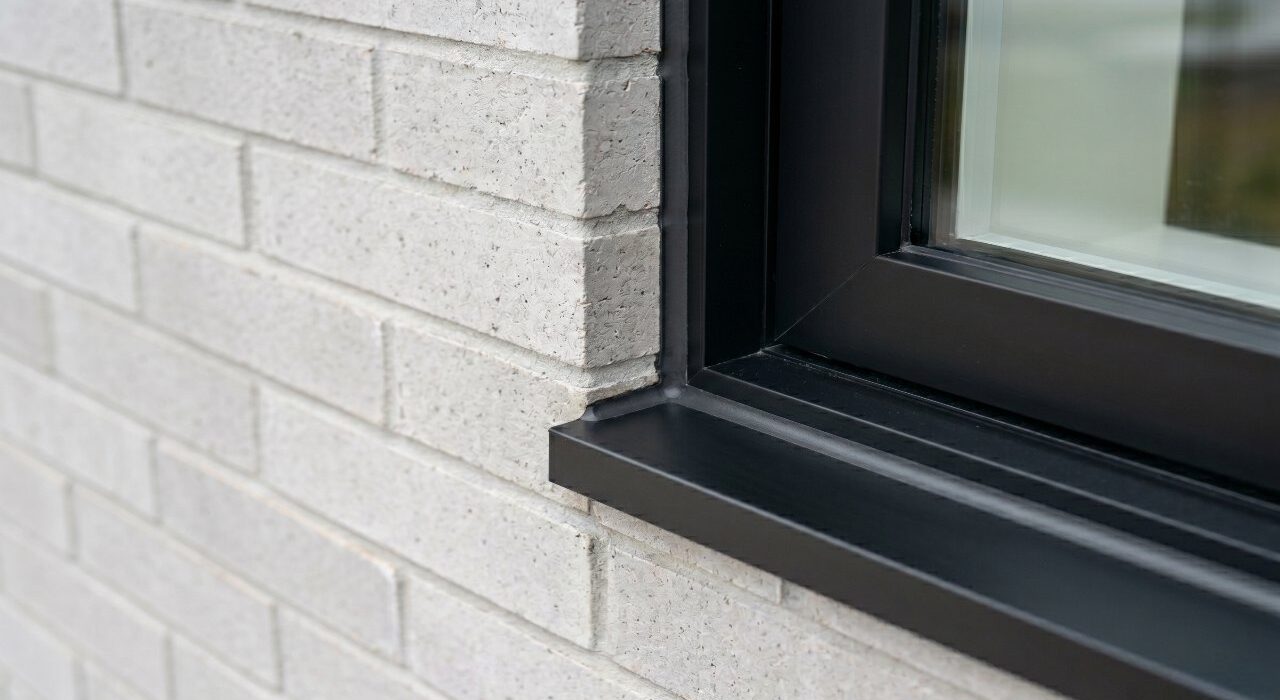
Understanding the physical mechanics of caulk drying vs curing is critical, despite both processes eventually producing what looks like a solid sealant bead. Drying is simple solvent or water evaporation where the material loses mass and shrinks, while curing is a molecular cross-linking reaction in which the polymer chains chemically bond to gain elastomeric strength.
Treating these two fundamentally different chemical transformations as interchangeable during Southern Ontario’s erratic weather patterns is the single most common cause of premature caulking failing across the region. A field crew that applies water-based acrylic latex and moisture-cure silicone using the exact same weather assumptions is guaranteed to lose one or the other to the season.
⏱️ Quick Answer
Standard water-based latex caulk requires dry weather between 10°C and 25°C to dry properly by evaporation. Premium moisture-cure silicones and advanced hybrids can handle freezing temperatures down to -5°C, but they will fail instantly if applied over an invisible, frozen layer of surface moisture. For a permanent seal, exterior substrates must be completely dry and clear of overnight frost.
Product Selection Guide: Best Caulking Types for Local Weather
Choosing the wrong sealant class for the current season is the single most common cause of envelope degradation across the QEW corridor. Different chemical formulations solidify using completely different mechanisms, meaning each product has a strict atmospheric window.
To properly evaluate how these different bases resist environmental stress, you can review our comprehensive exterior caulking materials comparison matrix.
| Sealant Class | Mechanism of Solidification | Ideal Temperature/RH Window | Southern Ontario Seasonal Risk |
|---|---|---|---|
| Acrylic Latex (water-based) | Evaporation of water carrier, no chemical reaction | 10°C to 25°C, RH below 70% | High humidity off Lake Ontario halts evaporation, causing wash-out or sag |
| 100% Silicone (acetoxy or alkoxy moisture-cure) | Moisture-triggered crosslinking using ambient humidity | -20°C to 35°C, requires only trace atmospheric moisture | Performs reliably in cold but fails if substrate carries frozen surface moisture |
| Polyurethane (Sikaflex/Dymonic class) | Moisture-cure isocyanate crosslinking | 5°C to 35°C, RH above 35% required | Halts almost completely below 5°C, common in Milton autumn nights |
| STPE/STPU Hybrids | Silyl-terminated moisture-cure, hybrid crosslinking | -5°C to 35°C, broader humidity tolerance than standard polyurethane | More resilient to marginal humidity swings but still vulnerable to frozen surface films |
Local Weather Traps: How Halton’s Microclimates Destroy New Caulking
The regional geography of Halton creates starkly contrasting microclimates that directly disrupt standard product label instructions. Failing to calibrate your installation to these specific environmental anomalies across the Escarpment corridors leads directly to rapid joint failure.
The Burlington Shoreline Moisture Siphon
Lake Ontario drives high relative humidity into Burlington and South Oakville throughout spring and early summer. This saturated boundary layer severely blocks the air from absorbing moisture. As a result, standard water-based latex caulk cannot dry.
If an unpredicted lake-breeze rain shower hits the site before a protective surface skin forms, the entire bead will liquefy and wash down your wall.
Even if it holds off raining, the extended open wet phase allows airborne pollen, dust, and coastal contaminants to embed into the soft paste, permanently ruining the clean aesthetic finish.
For an extensive technical breakdown on how this coastal moisture causes early envelope degradation, read our guide on Burlington condensation failure and leaking windows.
For real-time tracking of these local shoreline humidity spikes and atmospheric saturation points, contractors should monitor the official Environment Canada Weather Station tracker.
The Milton Escarpment Frost Window
Milton’s geographic elevation along the Niagara Escarpment produces sharp overnight temperature drops during autumn that low-lying urban coastal areas rarely experience.
These rapid evening drops cause building walls to fall below the local dew point, creating an immediate frost risk across exterior bricks and window frames.
Polyurethane and standard silicone beads applied late in the afternoon can sit in a completely stalled, unhardened state throughout these freezing overnight hours.
Because moisture-cure polymers require active atmospheric water molecules to trigger their chemical hardening, freezing conditions essentially lock up the available moisture.
This localized elevation effect is heavily influenced by the unique topography managed by the Niagara Escarpment Commission, which channels colder, denser air downward into residential construction zones. This delays the functional cure timeline by 24 to 48 hours and guarantees internal cell collapse.
Cold and Wet Weather Caulking Failures
When severe Great Lakes weather systems collide with Halton’s geography, the physical mechanics of a drying or curing sealant change instantly. Failing to anticipate these sudden environmental shifts leads directly to irreversible material failures.
Problem A: Wet Evaporation Failures
Water-based latex applied ahead of an incoming thunderstorm forms a thin surface skin within the first hour. This gives a false visual impression of progress.
Beneath that skin, the bead remains fully fluid because acrylic chemistry has no backup hardening mechanism once evaporation stalls.
When rain contacts that skinned-but-fluid bead, water intrusion through the thin layer causes catastrophic blistering and internal cell collapse.
The finished joint shows visible pitting, bubbling, or a collapsed cross-section that no longer matches its original tooled profile.
Problem B: Freezing Temperatures and Adhesion Failures
Moisture-cure silicone applied when the substrate temperature drops below 4°C faces a specific and severe failure mode.
Porous materials like concrete and brick frequently carry an invisible, microscopic film of surface water that freezes solid. This forms a physical bond-breaker layer between the wall and the new sealant.
The sealant appears to adhere visually at the moment of application, but it is actually bonding to a thin ice layer rather than the house itself.
Once that ice layer eventually melts and evaporates, the bead releases from the wall completely, producing a total failure weeks after a crew has left the site.
Problem C: Single-Day Temperature Shifts
The QEW corridor regularly experiences single-day temperature swings of twenty degrees Celsius or more during freeze-thaw transition periods in early spring and late autumn. These rapid swings change joint width dynamics faster than any standard cure schedule anticipates.
This occurs because the siding or brick materials respond to temperature changes far faster than an uncured polymer can build internal strength.
An uncured bead caught in one of these rapid transitions tears directly down its centre. The gap widens or narrows before the polymer chains have stitched together enough density to stretch elastically.
To find out more about preventing these structural split failures, check out our master troubleshooting checklist detailing why exterior caulking cracks and fails early.
FIELD CHECKLIST: SAFE WEATHER TESTING PROTOCOL
Before any crew loads a gun on a Halton job site, the following checks are mandatory and must be logged. These systematic field checks ensure that variable atmospheric conditions match manufacturer installation specifications before material application begins.
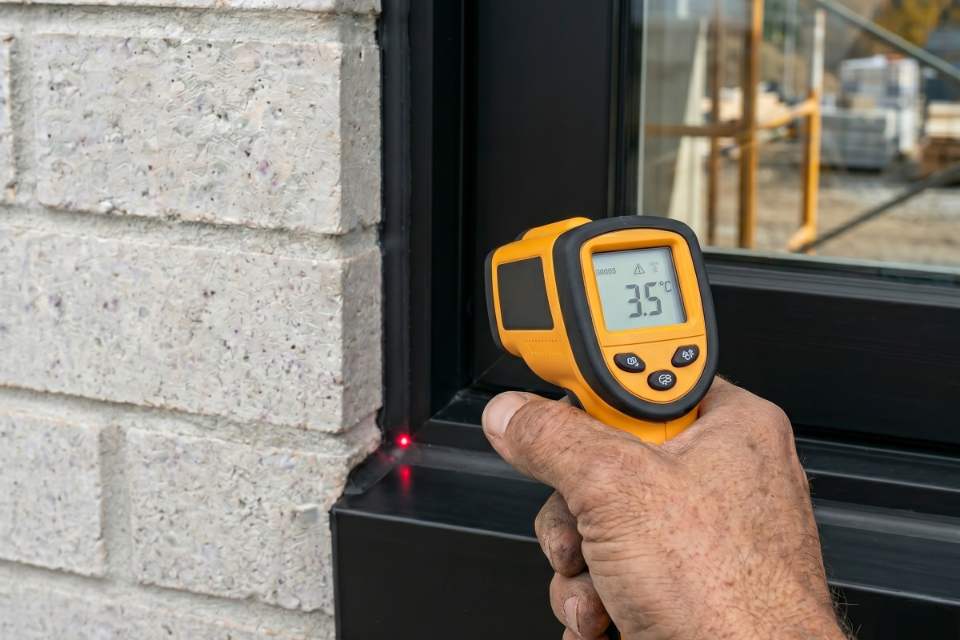
Step 1: Substrate Thermal Scan
Read substrate temperature directly using an infrared thermometer rather than relying on ambient air temperature, since substrate surfaces routinely run colder or hotter than the surrounding air depending on sun exposure and material mass. Confirm the reading sits within the specified product’s cure window before any material is gunned.
📐 Official Architectural Specification
According to the ASTM C1193 installation protocols, high-performance elastomeric sealants strictly require dry, uninhibited contact to achieve full structural crosslinking. Introducing liquid soaps or environmental moisture during active tooling permanently weakens the finished bead and causes catastrophic joint delamination.
Step 2: Dew Point Spread Check
Check the local dew point spread against current substrate temperature to determine whether the surface risks frost or condensation formation within the next several hours. A narrow spread, where dew point and substrate temperature sit within two or three degrees of each other, signals a high risk of moisture film formation during the cure window.
Step 3: Localized Cure Calibration
Calculate a regional caulk curing time multiplier based on the current local frost schedule and humidity conditions rather than relying solely on the manufacturer’s standard label timing. A Milton autumn evening application may require a multiplier of 1.5 to 2 times the labelled cure duration before the joint can be considered joint movement ready.
Step 4: Environmental Window Verification
Confirm the expected skin-over time against the arrival window of any incoming Great Lakes weather system using current forecast data. If a rain event is expected to arrive before the calculated skin-over time has elapsed, the application must be postponed regardless of project schedule pressure, since a washed-out or frost-compromised joint costs significantly more to remediate than a one-day scheduling delay.
For an extensive field diagnostic list to help your crew prevent these issues, check out our master troubleshooting checklist detailing why exterior caulking cracks and fails early.
SECURE YOUR CLIMATE-CALIBRATED WEATHER SEAL TODAY
Failing, wet-washed caulking compromises your building envelope and leads to costly internal moisture decay. Contact Oleg at Proper Caulking to get your exterior building envelope evaluated for seasonal moisture and frost vulnerabilities before the next major weather front hits.
Our technical field division across Oakville, Burlington, and Milton methodically calculates regional dew points and installs advanced all-weather hybrid polymers that resist aggressive freeze-thaw shifting.
Every premium residential or light commercial project we execute is strictly engineered to prevent wet-washouts, premature material tearing, and catastrophic adhesion failures along the QEW corridor.
Review your options below to secure a comprehensive, zero-obligation on-site assessment for your property facades.
Protect Your Building Envelope From Early Failure
Wet-washouts and freezing dew points destroy standard caulk applications. Contact our technical field division today to evaluate your building envelope and install advanced all-weather compounds.
Proper Caulking – Oakville, Burlington & Milton, Ontario