
Southern Ontario building envelopes absorb a severe mechanical assault driven by extreme seasonal temperature shifts. This environmental variance represents the single largest engineering variable when analyzing Silicone vs Polyurethane vs Acrylic Caulking performance parameters across the GTHA.
Every architectural building material responds to this intense seasonal thermal cycle differently based on its independent expansion rates. When mismatched materials share a common junction, the sealant bridging that dynamic gap must maintain flawless adhesion to prevent envelope failure.
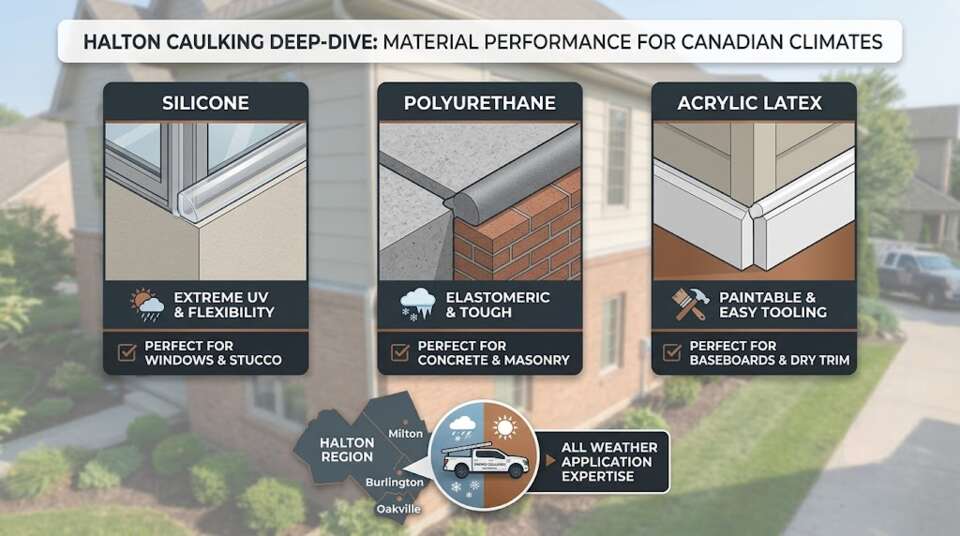
Caulking Comparison Table: Silicone vs. Polyurethane vs. Acrylic
| Property | Silicone | Polyurethane | Acrylic Latex / Premium Elastomeric |
|---|---|---|---|
| Chemical Base | Inorganic siloxane polymer | Organic polyether/polyester polymer | Water-based acrylic polymer emulsion |
| Maximum Joint Movement | ±25% to ±50%+ (ASTM C920) | ±25% to ±35% (ASTM C920) | 5% to 12.5% (Premium grades up to ±25%) |
| Sub-Zero Gunnability | Yes. Stable down to -20°C. | No. Requires > +5°C ambient. | No. Emulsion freezes below 0°C. |
| Curing Kinetics | Moisture crosslinking. Full cure: 24–72 hrs. | Isocyanate vulcanization. Full cure: 3–7 days. | Evaporation. Shrinks 15–25%. Full cure: 7–14 days. |
| Paint & UV Profile | Unpaintable. Lifetime UV immunity. | Paintable. Prone to UV surface chalking. | Highly paintable. Poor exterior UV life. |
| Substrate Bond | Non-porous (glass, metal, tile). | Porous (concrete, brick, timber). | Porous interior substrates and trim only. |
| GTHA Lifespan | 20+ years on glazing and metal. | 10 to 15 years on masonry joints. | 2 to 5 years exterior; 10+ years interior. |
Chemical Compound Deep-Dives
Compound A: Silicone (The Inorganic Elastomer)
Silicone sealants are engineered on a foundational siloxane backbone consisting of an inorganic silicon-oxygen molecular chain. Unlike carbon-based organic polymers, this inorganic structure is entirely immune to ultraviolet photodegradation.
This specific molecular stability makes silicone the only acceptable technical specification for high-exposure architectural elements like structural glass facades and storefronts. It is also the ideal choice for residential architectural components, including detailed window glazing caulking glass frame seals across Oakville and Burlington’s high-wind lakeside corridors.
UV radiation lacks the energy required to break down these atomic silicon bonds. An architectural silicone joint installed on a south-facing exterior assembly will maintain its elasticity for decades.
In comparison, an organic polyurethane alternative in the same high-exposure orientation will rapidly chalk, harden, and split. Silicone’s moisture-cure mechanism utilizes ambient humidity rather than liquid water molecules to crosslink.
This delivers a massive operational advantage during Canadian winters because the material can be successfully dispensed in temperatures as low as -20°C. The non-negotiable field condition is that the substrate must be completely free of microscopic frost contamination.
Achieving a clean surface requires an aggressive, dual-rag solvent wipe using isopropyl alcohol prior to application. This cold-weather stability makes silicone the sole viable option for emergency winter glass remediations or storefront envelope repairs.
The primary limitation of this specific chemistry is its complete lack of paintability. Cured silicone features a low surface energy that repels all architectural topcoats, causing paint to fish-eye and peel.
This non-paintable profile is highly advantageous in wet residential zones, making it the required choice for installations involving interior kitchen bathroom silicone caulking or custom kitchen backsplash countertop silicone treatments. However, silicone migration remains a critical liability on high-end custom residential building sites.
If uncured silicone fluid is transferred via contaminated tools or gloves onto adjacent wood trim, it permanently seals that substrate. No amount of primer or paint will ever bond to that contaminated zone again, which frequently forces builders to cut out and completely replace expensive architectural finishes.
Premium commercial lines specified for this structural tier include DOWSIL 795 Silicone Building Sealant, which features a ±50% movement capability. Commercial envelope installers also rely on specialized alternatives like Tremco Spectrem Architectural Weatherseal to survive harsh coastal deltas.
Compound B: Polyurethane (The Heavy-Duty Organic Shield)
Polyurethane sealants are tough, organic polymers formulated from dense polyether or polyester chains. They are favored for their high tensile strength, exceptional tear resistance, and high Shore A hardness ratings.
These mechanical properties make polyurethane the correct engineering choice for concrete isolation joints and brick-to-masonry transitions. It is also preferred for foundation-to-wood interfaces where joints endure structural settling, pedestrian traffic, and physical vibration.
Polyurethane achieves a deep, aggressive mechanical interlock within the rough, porous profiles of concrete, stone, and brick. This anchoring mechanism forms a bond that smoother, non-reactive silicones simply cannot replicate.
The curing process relies on moisture-triggered isocyanate crosslinking to connect the polymer chains. This requirement represents polyurethane’s primary performance vulnerability within the shifting Canadian climate.
When ambient temperatures drop below +5°C, this chemical crosslinking reaction slows drastically and eventually halts entirely. A polyurethane bead gunned during late autumn on an unheated Halton jobsite may develop a superficial skin.
This skin gives the illusion of a successful install while the material remains completely uncured and fluid underneath. When winter arrives and thermal contraction forces the building joints to widen, this unlinked polymer experiences immediate cohesive failure.
Polyurethane also features an inherent vulnerability to long-term solar radiation over extended lifecycles. Its organic carbon-carbon bonds are susceptible to photo-oxidation, causing the material to yellow and chalk under sustained UV exposure.
Because of this degradation, any exterior polyurethane joint on a southern or western elevation must be topcoated with paint. Protecting the bead shields the polymer from UV breakdown and ensures it reaches its 15-year functional lifespan.
Commercial mechanics rely heavily on Sika Sikaflex-1A Joint Sealant for vertical moving joints due to its high cut-and-tear resistance. For horizontal expansion joints, general contractors mandate specifications like Tremco Dymonic 100 Polyurethane Sealant for code-compliant architectural sealing.
Compound C: Acrylic Latex and Elastomerics (The Interior Finisher)
A profound performance gap exists between low-grade commodity caulks and advanced elastomeric emulsions within this category. Standard, entry-level painter’s caulk is a rigid, water-based acrylic designed strictly for high-speed, high-volume production work.
It cures through simple water evaporation, which causes severe volumetric shrinkage as the fluid leaves the bead. The compound frequently loses 20% to 25% of its total mass during the drying phase.
This loss leaves a thin, brittle plastic profile with less than 10% elongation capability. If applied to exterior building envelopes or high-movement joints, this structural rigidity guarantees failure.
The first severe winter freeze-thaw cycle will completely snap the brittle bead. Premium elastomeric acrylics occupy a vastly different performance tier.
Advanced formulas like Sashco Big Stretch Elastomeric Sealant are engineered with dense plasticizing packages and pure acrylic polymers. These additives grant true elastomeric properties, allowing the material to stretch up to 530% without cracking under stress.
This movement capability matches mid-tier polyurethane performance while retaining acrylic’s primary asset. It allows instant, effortless topcoat paintability with zero risk of surface chemical rejection, making it a critical asset during detailed baseboard trim caulking procedures.
Another industry-standard alternative used for flexible interior casing preparation is DAP Extreme Stretch Premium Sealant, which dries to a 100% crackproof finish. Despite these engineered improvements, water-emulsion chemistry dictates that acrylic sealants remain strictly inside the conditioned building envelope.
Their ideal applications include crown mouldings, baseboards, door casings, and drywall-to-frame transitions. Using even premium elastomeric acrylics on exterior assemblies in Canada exposes them to two distinct failure modes.
First, if an un-cured exterior bead is hit by rainfall, the water-soluble emulsion will liquefy and wash away. Second, if it survives to winter, the cured bead will experience freeze-fracture because its water-derived base cannot handle outdoor temperature drops.
Critical Canadian Installation Protocols
The Sub-Zero Frost Trap
Cold substrates below freezing develop a microscopic, often invisible layer of surface frost or condensation, even when the substrate appears visually dry. Gunning any sealant directly onto that frosted surface produces a bond that looks acceptable at installation and fails completely within one freeze-thaw cycle.
This happens because the sealant cures against a temporary frost layer rather than the structural substrate itself. The mandatory field correction for local crews is a strict two-rag solvent wipe method.
The first rag, dampened with isopropyl alcohol or methyl ethyl ketone (MEK), strips away the frost and surface contamination. The second rag, which must be completely dry, immediately follows to remove residual solvent before it refreezes on the surface.
Skipping this second dry rag pass is a common and costly field error that leads to complete adhesion failure. Understanding these climate realities is exactly why does caulk crack in Burlington weather when rapid thermal drops hit fresh installations.
The Golden Rule of Three-Sided Adhesion
A sealant bead bonded to three surfaces—the two opposing joint faces plus the back of the cavity—cannot stretch elastically. When the joint moves, the bead has nowhere to safely flex and tears through its own cohesive body instead.
The mandatory correction is establishing pure two-sided adhesion only. Technicians achieve this separation by inserting a specialized what is backer rod window sealing component into deep structural joints.
For shallow joints where depth is limited, installers must apply a polyethylene bond-breaker tape to the rear wall. Both methods ensure the sealant bonds exclusively to the two opposing faces it is meant to dynamically bridge.
This mechanical isolation is crucial when managing a highly volatile exterior transition caulking dissimilar materials joint that experiences competing expansion rates.
Joint Geometry Dynamics
The governing building standard for structural silicone and polyurethane joints is maintaining a strict 2:1 width-to-depth ratio. For example, a 12mm wide joint must be backed to a precise 6mm sealant depth.
This specific ratio produces the correct hourglass cross-section configuration when the joint is placed under tension. It distributes physical stress evenly across the bond line rather than concentrating it at the centre of an overfilled, square-profile bead.
Adhering to these geometric dimensions is critical for large-scale brick masonry expansion joint caulking assemblies that face direct sun exposure. It also prevents premature failures along a heavy-duty porch to house expansion joint caulking line where structural shifting is constant.
Specification Checklist for the Halton Job Site
Before any crew gun touches a substrate, site supervisors must verify the basic material distribution rules. Glass, metal, or storefront glazing systems must receive a high-performance architectural silicone, full stop.
Concrete, brick, masonry, or any porous structural joint exposed to heavy traffic or physical movement requires a tough polyurethane compound. This organic formulation must only be applied when ambient conditions remain strictly above +5°C to ensure proper chemical crosslinking.
Interior trim assemblies, crown mouldings, and baseboard junctions require a premium elastomeric acrylic latex emulsion. Standard commodity painter’s caulk must never be deployed on any finished interior joint expected to experience dynamic movement.
Supervisors must actively confirm the current substrate temperature and check for invisible frost conditions before every exterior application. Furthermore, field technicians must verify that a closed-cell foam backing rod is installed in every joint exceeding standard depth-to-width tolerances.
The specific tube loaded in the caulking gun must perfectly match the underlying substrate, the environmental exposure, and the current Canadian season. Failing to align these physical parameters means the warranty on the architectural work is functionally meaningless before the bead is even tooled.
Adhering to this structured field review is critical when managing high-exposure setups like commercial exterior caulking services across the Golden Horseshoe. Taking the time to double-check your materials protects the building envelope and helps save on AC bills with strategic caulking in Burlington over long-term building lifecycles.
Prevent Catastrophic Weatherseal Failures
Don’t let incorrect compound selections or hidden sub-zero frost layers compromise your structural building joints this season. Contact our engineering-minded field technicians for a comprehensive, professional envelope sealing evaluation today.
Proper Caulking – Oakville, Burlington & Milton, Ontario
Frequently Asked Questions: Silicone vs. Polyurethane vs. Acrylic Latex
Can I paint over silicone sealant if I use a premium oil-based primer first?
No, you absolutely cannot paint over silicone regardless of the primer chemistry or application technique used. The low surface energy of a cured siloxane polymer forces all architectural topcoats to immediately bead up, separate, and peel away from the surface.
What happens if polyurethane sealant is applied to an unheated joint below +5°C?
The moisture-triggered isocyanate crosslinking reaction slows down dramatically or halts entirely when temperatures drop below this critical threshold. The material may develop a deceptive surface skin while remaining chemically uncured underneath, leading to immediate cohesive tearing when winter thermal contraction forces the building joints to widen.
Why does cheap painter’s caulk split open during its first Canadian winter?
Standard commodity acrylic latex caulk cures through physical water evaporation, which triggers massive volumetric shrinkage between 20% and 25%. This process leaves behind a thin, brittle plastic profile that completely lacks dynamic elongation properties and fractures instantly when subjected to freezing temperatures or truss uplift forces.
Is it possible to apply high-performance silicone to a damp concrete surface?
No, silicone requires a completely dry, frost-free substrate face to achieve proper molecular adhesion. Any surface moisture or micro-frost layers will create a barrier between the sealant and the concrete, resulting in complete bond failure during subsequent freeze-thaw cycles.
How can field crews quickly differentiate between polyurethane and advanced elastomeric acrylic tubes on site?
Polyurethane sealants will explicitly reference industrial structural standards like ASTM C920 on the label jacket and require chemical solvents for clean-up. Premium elastomeric acrylics will be labeled as water-clean-up formulations and prominently market their interior topcoat paintability advantages.