
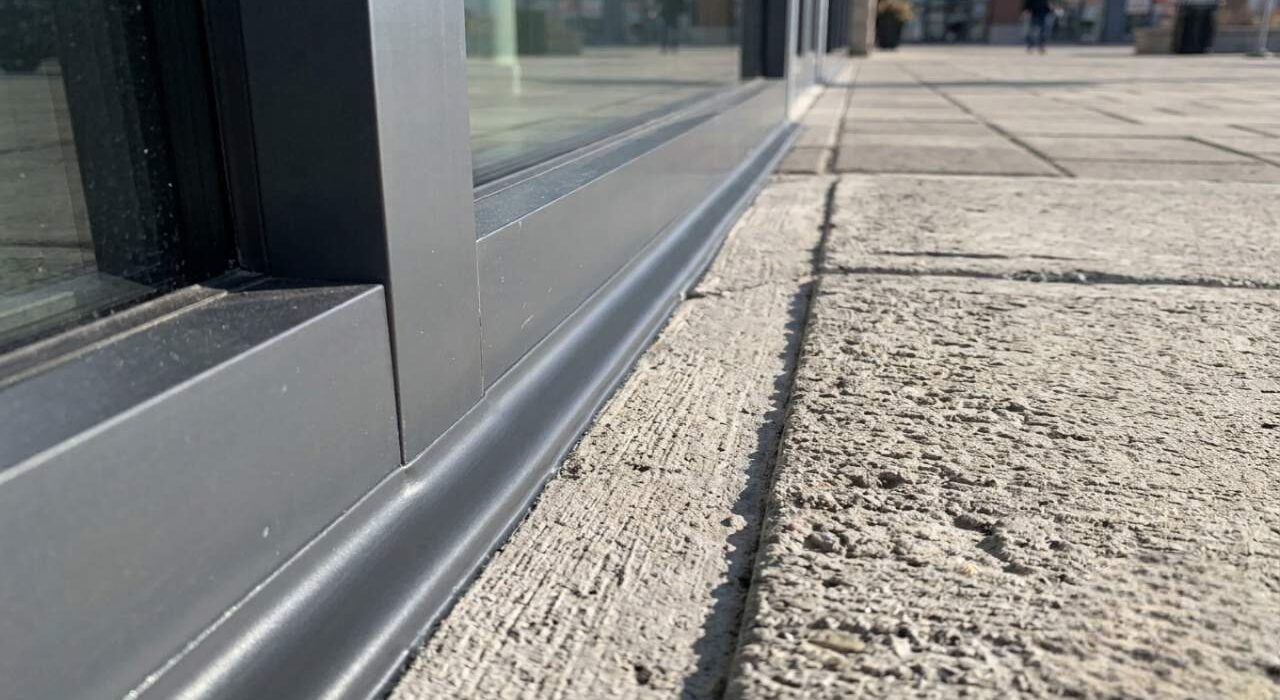
Maintaining a fully functional, weatherproof building envelope across a commercial retail property requires strict mechanical attention to large horizontal-to-vertical joint interfaces. Most property managers and plaza maintenance teams focus their structural repair budgets on main roof systems and large brick walls while entirely ignoring the flat base zones where public concrete paths meet metal structural glass systems.
In reality, neglecting these perimeter expansion seams and failing to execute professional commercial storefront caulking along structural building aprons creates an open invite for bulk water infiltration. This continuous water pooling rapidly seeps past structural slab lines, floods underground commercial utility networks, and triggers structural foundation shifting that leads to incredibly costly storefront framing replacements.
⏱️ Quick Answer
Commercial storefront apron joints require heavy-duty, multi-component polyurethanes (like Sikaflex-2c NS) rather than standard silicones to withstand heavy foot traffic and puncture loads. Because concrete walkways heave and shift independently from fixed store foundations, installing a high-density backer rod to maintain a strict 2:1 width-to-depth structural ratio is mandatory to prevent center tearing and foundation flooding.
JOINT PARAMETER CHART: TRANSITION TRAFFIC CONDITIONS
When an active public pedestrian sidewalk meets a vertical commercial storefront frame, it introduces complex structural stress factors based on heavy foot traffic and outdoor climate shifts. Before injecting raw elastomeric compounds into a commercial apron joint, trade supervisors must evaluate the specific physical conditions of the transition area.
| Apron Joint Substrate Intersection | Joint Width Profile | Primary Weather Threat | Pedestrian Load Conditions | Recommended Sealant Compound |
|---|---|---|---|---|
| Anodized Aluminum Frame to Poured Concrete | 12mm to 20mm Uniform | Salt-laden winter puddle ponding | Heavy pedestrian foot traffic | Traffic-Grade Multi-Component Polyurethane |
| Rigid Clay Face Brick to Cast Concrete Slab | 15mm to 30mm Irregular | Heavy vertical wall runoff saturation | Medium trolley and cart loading | High-Movement Low-Modulus Advanced Hybrid |
| Structural Granite Block Veneer to Pavement | 10mm to 18mm Variegated | Capillary water suction into stone beds | Light pedestrian border walking | Non-Staining Chemically Cross-Linked Hybrid |
THE MECHANICAL SCIENCE OF FLAT HORIZONTAL COUPLINGS
The physical conflict surrounding a retail sidewalk-to-storefront apron joint is driven entirely by the continuous dimensional changes between two totally different structural elements. The outdoor poured concrete sidewalk slab rests directly on a compacted stone base, making it highly vulnerable to ground shifting and frost heaving during local Southern Ontario winter freeze-thaw cycles.
Conversely, the vertical metal storefront framework is anchored straight to the property’s structural foundation walls, keeping it completely stable while the outdoor concrete moves up and down independently. This ongoing movement creates an aggressive shearing stress that tears apart low-grade retail caulking within a single season, transforming a tight seal into an open structural trench.
WHY WATER PONDING DESTROYS INTERIOR CONCRETE SLABS
Because commercial sidewalks are poured with a slight slope to shed driving rain away from retail entry doors, any failure along the base connection point forms an immediate water trap. When rainwater sheets down large commercial glass windows, it pools heavily at the bottom metal frame before running directly into the unsealed expansion line.
Structural Cavity Flooding
Once water enters an unsealed apron joint, gravity forces the liquid deep into the sub-base layers beneath the main commercial walkway. This continuous moisture loop rapidly washes away the underlying support sand, causing the exterior concrete slabs to sink, tilt, and crack unevenly along your main walkways.
Perimeter Joint Extraction and Preparation Protocol
- Execute complete mechanical extraction of deteriorated caulking using specialized oscillating joint cutters without scoring anodized aluminum frame finishes.
- Wire-brush and high-pressure blow out porous concrete joint faces to clear residual de-icing salt crystals and pulverized sub-base sand.
- Verify joint width consistency across the storefront apron line to calculate optimal high-density backing rod diameter scales.
The Trip-and-Fall Liability Trigger
As the concrete sidewalk panels sink unevenly against the rigid metal storefront frames, they create jagged, dangerous steps right along your main storefront paths.
For commercial plaza owners, these uneven concrete lips act as a direct trigger for expensive public trip-and-fall lawsuits, making routine expansion line repairs an absolute priority to protect your business assets, a risk profile explored in our comprehensive service breakdown of commercial exterior caulking services.
PRODUCT SELECTION: TRAFFIC DECK FORMULATIONS VS. RETAIL SILICONES
Remediating an active commercial storefront transition requires specifying heavy-duty, multi-component traffic-grade polyurethanes or advanced low-modulus hybrid polymers designed to withstand high movement.
Utilizing generic, consumer-grade tubes from a local big-box store is a total waste of company resources, as these weak materials lack the necessary puncture resistance and Shore A hardness values required to handle public foot traffic.
Puncture-Resistant Multi-Component Polyurethanes
Our commercial remediation crews prevent slab undermining by deploying elite, multi-part traffic formulations like Sikaflex-2c NS (Non-Sag) or MasterSeal NP 2.
These specialized multi-part polyurethanes deliver an exceptional combination of high adhesive bonding strength and raw tear resistance, allowing the cured bead to endure continuous foot traffic and heavy shopping carts without peeling.
These advanced compounds stretch reliably without shearing off the metal anodized aluminum window tracks, ensuring a long-lasting, watertight seal.
To guarantee an permanent, code-approved seal along these high-traffic retail aprons, technicians must treat the porous concrete walls with a dedicated primer like Sika Primer-215 prior to polymer extrusion.
This chemical bond layer prevents salt-laden winter brines from unzipping the bead from the sub-base.
Low-Modulus Advanced Hybrids
For architectural facades constructed with decorative natural stone trim or sensitive limestone wall blocks, field teams should substitute standard polyurethanes with non-staining hybrid polymers. These non-staining materials prevent ugly carrier oils from leaching into your building’s stonework while maintaining maximum elastic flexibility across wide expansion joints.
To cross-reference the formal laboratory testing methodologies and mechanical structural specifications that govern high-movement commercial glass and pavement sealant connections, asset managers should consult the technical selection guidelines maintained directly by the Dow Building Science Structural Glazing Directory.
SAFEGUARD YOUR COMMERCIAL PROPERTY INVESTMENTS TODAY
Reach out to Oleg at Proper Caulking to coordinate a meticulous building envelope evaluation and eliminate hidden water leaks before changing weather patterns damage your interior structural slabs. Our specialized commercial remediation crews operate throughout Oakville, Burlington, and Milton, combining deep material science expertise with high-pressure joint extraction and precision tooling protocols.
Every premium commercial retail transition we execute is strictly managed using heavy-duty, traffic-grade polymers to guarantee clean sightlines and permanent weather protection. Review your options below to speak directly with our local team and schedule your comprehensive, zero-obligation on-site commercial transition assessment.
Protect Your Plaza From Water Damage and Liability
Open concrete apron joints allow driving rain to flood underlying foundations and create dangerous, uneven trip hazards. Contact our commercial transition division today to secure your storefront parameters with high-performance, traffic-grade polyurethanes.
Proper Caulking – Oakville, Burlington & Milton, Ontario
Questions Property Managers Ask About Storefront Apron Joints
Can my standard parking lot asphalt crew seal the storefront concrete apron joint with hot rubber tar?
No, hot-applied rubberized asphalt tar should never be used against aluminum storefront windows because the extreme heat will instantly distort thin metal framing channels and melt your internal rubber glazing gaskets. Additionally, hot asphalt lacks the specialized structural adhesion chemistry required to grip anodized window metals, causing the seal to pull away from the metal within a few weeks.
How deep must a technician pack the backer rod inside a wide sidewalk apron joint gap?
For wide commercial joints measuring anywhere from 12 millimetres to 20 millimetres across, the high-density backer rod must be packed down to a depth that equals exactly half of the joint’s total width. Seating the foam backing rod at this depth keeps the final tooled bead at the perfect 2:1 width-to-depth structural ratio, which prevents center tearing.
Why does salt used for winter ice control speed up the failure of cheap storefront caulk beads?
Low-grade consumer caulking lines dry out into a rigid state, leaving microscopic cracks along the bond line over months of exposure to changing weather. When winter ice-melt salt dissolves into standing water, it forms a highly corrosive brine that seeps straight into those cracks, rapidly attacking the underlying adhesive bond until the caulk peels completely off the concrete window ledges.
Is a self-leveling polyurethane caulk safe to use when filling a horizontal storefront seam?
Self-leveling polyurethanes work wonderfully for long, flat concrete-to-concrete driveway seams, but they are too fluid to use against vertical window frames because the wet material will slump out of the channel before curing. For a proper storefront frame connection, installers must specify a non-sag, moisture-cure polyurethane that holds its shape inside the joint during application.
What is the typical service lifespan of a commercial-grade traffic joint along a retail sidewalk?
When a high-performance, multi-component polyurethane is installed over a clean, primed substrate using proper backing rods, a professional apron joint can easily last between 8 to 12 years. High-traffic areas exposed to continuous snow clearing and power washing should be checked every five years to fix minor surface wear before water can damage the underlying foundation.