
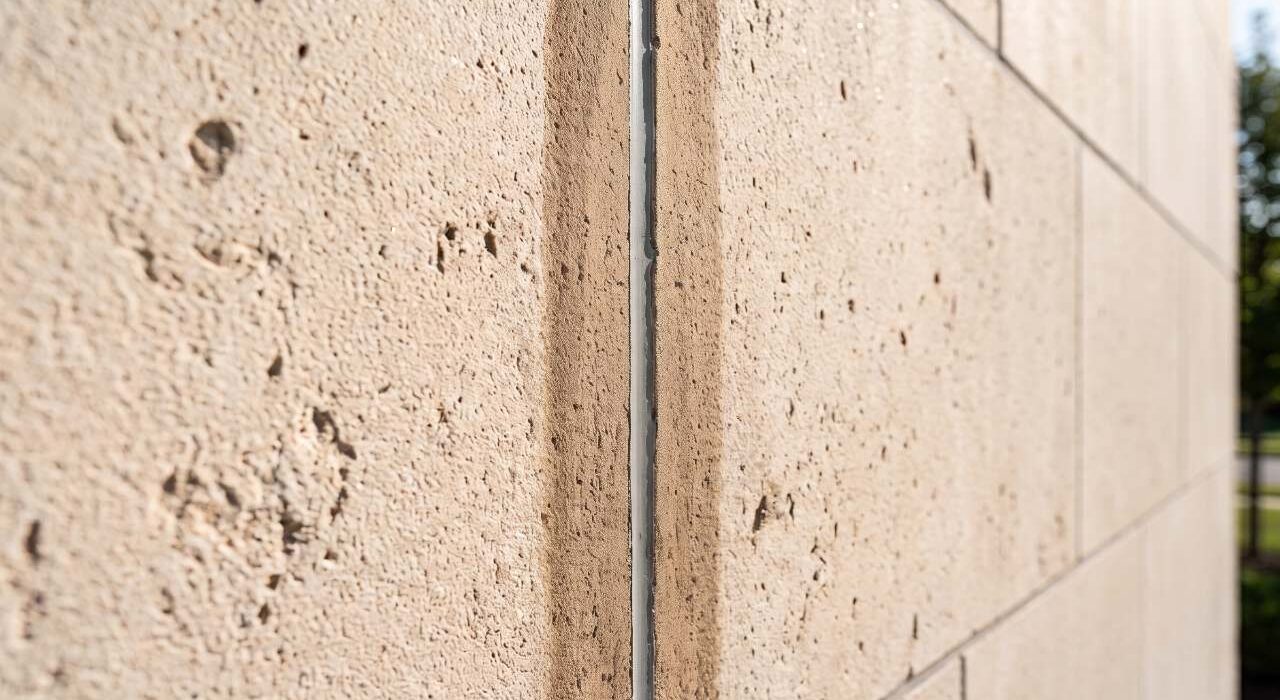
Preserving the immaculate appearance of premium masonry installations requires an analytical engineering approach to prevent caulk bleeding on light stone from permanently ruining custom residential facades. Most non-specialized painting crews and general handymen mistakenly assume that any standard exterior silicone is safe to apply across high-end residential walls.
In reality, utilizing uncalibrated retail compounds against porous masonry triggers an irreversible fluid migration defect that permanently alters the stone’s chemical structure. This severe oil leaching forces property owners to face incredibly costly facade restorations or complete block replacements after just a single season of Southern Ontario weather exposure.
⏱️ Quick Answer
Standard retail silicones contain unbonded plasticizer oils that seep into porous stone like Indiana limestone or marble, leaving permanent grease halos. To prevent fluid migration stains, you must install premium non-staining silicones (like Pecora 890NST) or advanced MS-Polymer hybrids that pass the strict ASTM C1248 discoloration standard.
When a building envelope is breached by chemical oil migration, the structural value of the masonry assembly drops significantly. The continuous leaking of petroleum carriers turns a pristine architectural design into a heavily stained eyesore that permanently lowers curb appeal.
MATERIAL REACTION MATRIX: SEALANT FLUID MIGRATION
When a fluid compound is applied to a masonry joint, its internal carrier oils react uniquely based on the chemical density of the substrate face. Before injecting any polymer into a premium stone facade, field supervisors must analyze how specific stone varieties handle fluid absorption.
| Stone Substrate Variety | Relative Density Profile | Capillary Pore Structure | Fluid Bleeding Vulnerability | Recommended Sealant Type |
|---|---|---|---|---|
| Indiana Limestone | Low to Medium Density | Open / Interconnected | Extremely High | Non-Bleeding Premium Hybrid |
| Carrera Marble | High Density | Tight / Microscopic | Moderate to High | Non-Staining Neutral Silicone |
| Exposed Aggregate Concrete | High Density | Coarse / Irregular | Low to Moderate | High-Elongation Polyurethane |
THE CHEMISTRY OF SILICONE OIL MIGRATION
The destructive phenomenon of oil migration is driven entirely by the presence of unbonded plasticizers and free silicone fluids within low-cost, acetoxy-cure or standard alkoxy-cure sealants. Standard retail silicones rely on these liquid carriers to maintain their long-term flexibility, but the oils remain chemically unstable within the cured polymer matrix.
To prevent this aesthetic catastrophe, our architectural project specifications strictly mandate high-movement compounds that have passed the full ASTM C1248 laboratory matrix for fluid migration and substrate discoloration.
Over months of exposure to changing Southern Ontario weather patterns, these unbonded silicone fluids slowly leach out of the bead and seep directly into the adjacent masonry faces. Because light natural stone possesses a highly porous, interconnected capillary network, it siphons the migrating oil deep into its mineral structure like an organic sponge.
Our custom home remediation division completely eliminates this threat by applying elite, non-staining technologies such as Pecora 890NST (Non-Staining Technology) and Dowsil 756 SMS which contain zero migratory fluid plasticizers.
This structural absorption completely fills the open pore spaces of the masonry, blocking the stone from its natural breathing cycles. Once the liquid plasticizers wrap around the mineral grains, they create a permanent chemical lock that cannot be dissolved by rain or air movement.
As regional ambient temperatures rise during hot summer afternoons, the trapped oil expands within the stone’s internal crystal matrix. This repeating internal thermal expansion cycle slowly weakens the mineral bonds, leading to microscopic cracking and surface spalling directly along the joint borders.
The Permanent Anatomy of a Silicone Stain
Once the fluid plasticizers cross the joint line and penetrate the natural stone pores, they permanently alter the optical density of the mineral facade. This deep absorption manifests as a dark, greasy-looking halo or oil band wrapping around the borders of every single caulked seam across your home.
The Magnetic Dust Effect
The migrated silicone oil does not evaporate or dry out; instead, it creates a permanently tacky, sticky field deep within the stone’s upper layers. This oil network acts as a relentless magnet for atmospheric dust, microscopic soot, vehicle exhaust fumes, and loose dirt blowing through the Halton Region corridor.
The Irreversible Stain Vector
As airborne contaminants continuously stick to the oily stone, they bake into the mineral pores under direct afternoon sun exposure, turning the dark halo into a permanent black or yellow shadow. Standard power washing, high-pressure steam, or harsh acid-etching detergents cannot draw the baked-in oils out of the stone matrix, ensuring the premium facade remains permanently discolored.
Attempting to blast these grease halos with abrasive blasting often ends up profile-scarring the soft underlying limestone completely. The fluid contamination is an un-remediable structural defect, meaning prevention during the initial installation phase with an engineered polymer like Pecora 890NST is the only real path to success.
Furthermore, these dark shadow bands expand outward by several millimetres each year as gravity and capillary action drive the oil deeper into the facade. What begins as a thin, barely noticeable discolouration eventually broadens into a massive, jagged stain zone that ruins the crisp layout of the entire wall panel system.
THE PERMANENT ANATOMY OF A SILICONE STAIN
Once the fluid plasticizers cross the joint line and penetrate the natural stone pores, they permanently alter the optical density of the mineral facade. This deep absorption manifests as a dark, greasy-looking halo or oil band wrapping around the borders of every single caulked seam across your home. Our field diagnostic teams routinely document these structural oil bands expanding up to 15 millimetres deep into porous limestone profiles within just 12 months of installation.
The Magnetic Dust Effect
The migrated silicone oil does not evaporate or dry out; instead, it creates a permanently tacky, sticky field deep within the stone’s upper layers. This oil network acts as a relentless magnet for atmospheric dust, microscopic soot, vehicle exhaust fumes, and loose dirt blowing through the Halton Region corridor.
Because the unbonded silicone fluids remain completely fluid inside the stone’s crystal matrix, they continuously pull environmental pollution straight into the stone’s face.
The Irreversible Stain Vector
As airborne contaminants continuously stick to the oily stone, they bake into the mineral pores under direct afternoon sun exposure, turning the dark halo into a permanent black or yellow shadow. Standard power washing, high-pressure steam, or harsh acid-etching detergents cannot draw the baked-in oils out of the stone matrix, ensuring the premium facade remains permanently discolored.
Attempting to blast these grease halos with abrasive media blasting often ends up profile-scarring the soft underlying limestone completely, destroying the factory-milled finish of your wall panels. The fluid contamination is an un-remediable structural defect, meaning prevention during the initial installation phase with an engineered polymer like Pecora Non-Staining Technology (NST) is the only real path to success.
Furthermore, these dark shadow bands expand outward by several millimetres each year as gravity and capillary action drive the oil deeper into the facade. What begins as a thin, barely noticeable discolouration eventually broadens into a massive, jagged stain zone that completely ruins the crisp, clean lines of your entire architectural wall panel layout.
PRODUCT SELECTION: STRIP-TESTING AND NON-STAINING POLYMERS
Preventing this catastrophic aesthetic failure requires specifying advanced, chemically engineered non-bleeding and non-staining hybrid sealants that contain absolutely zero fluid plasticizers. These premium formulations substitute traditional liquid carriers with cross-linked polymers that bind permanently within the compound as it cures.
Non-Staining Silicones
Premium non-staining silicones are explicitly engineered to eliminate plasticizer migration, passing strict long-term testing criteria without releasing a single drop of fluid oil into adjacent substrates. These specialized compounds are paramount for maintaining clean lines on high-end marble or granite intersections, as highlighted in our technical breakdown of luxury shower silicone replacement.
Advanced Silyl-Modified Hybrids
Advanced silyl-modified polyethers (MS-Polymers) represent the absolute gold standard for protecting highly sensitive Indiana limestone and soft sandstone facades. These formulas deliver exceptional adhesion to porous faces without any acidic byproducts, ensuring complete joint movement capability without any risk of oil migration.
To evaluate the exact field-testing methodologies, substrate staining potentials, and mechanical properties required for sealing non-staining masonry facades, building specifiers should reference the structural matrix protocols maintained by the Sika EMSEAL Architectural Joint Division.
LOCK IN ELITE ARCHITECTURAL FACADE PROTECTION
Reach out to Oleg at Proper Caulking to coordinate a meticulous building envelope evaluation and safeguard your premium stonework from destructive chemical staining. Our specialized custom home remediation crews operate across Oakville, Burlington, and Milton, combining deep material science expertise with precision mechanical installation protocols.
Every premium stone project we execute is strictly managed using non-staining, chemically cross-linked hybrid polymers to guarantee clean lines and enduring structural weather defense. Review your options below to speak directly with our local team and schedule your comprehensive, zero-obligation on-site masonry transition assessment.
Our technical crews are thoroughly trained in handling sensitive, high-value materials with the care and scientific background they require. Securing your perimeter joints with our specialized hybrid compounds eliminates the threat of oil leaching, keeping your custom architecture pristine for decades.
Preserve Premium Architectural Stone
Cheap retail caulk bleeds unstable silicone oil deep into porous limestone, causing permanent black shadows. Contact our luxury remediation division today to secure your custom facade with calibrated non-staining hybrids.
Proper Caulking – Oakville, Burlington & Milton, Ontario
Frequently Asked Questions on Caulk Bleeding on Light Stone
Can a professional pressure washer blast a silicone oil stain out of porous limestone?
No, high-pressure washing or hot-water blasting cannot remove a silicone stain because the oil is not sitting on the surface of the stone. The fluid has been drawn deep into the microscopic capillary pores of the mineral structure via suction, making mechanical removal physically impossible.
How long does it typically take for a cheap caulk bead to start staining stone?
Depending on the volume of unbonded plasticizers inside the compound and direct UV exposure, oil migration typically begins within 3 to 6 months of installation. The dark, wet-looking halo will steadily broaden over the first two years until the cartridge has completely depleted its free fluid content.
Is a polyurethane sealant safer than a standard retail silicone for light granite facades?
Yes, high-grade polyurethanes do not rely on free silicone fluids for flexibility, making them significantly safer against porous granite transitions. However, traditional polyurethanes carry strict weather application limits and can experience surface chalking if exposed to intense UV rays without an advanced hybrid modifier.
What is the purpose of the ASTM C1248 laboratory standard mentioned in the article?
The ASTM C1248 standard is the formal global testing protocol used to determine if a joint sealant will cause substrate discoloration. Manufacturers must compress sealant samples between blocks of real stone and bake them in high-heat ovens to verify that no oils leach out of the rubber.
Can you apply a chemical poultice to extract oil stains from custom marble tiles?
In minor interior scenarios, a technical poultice made of solvent and absorbent powder can sometimes draw out a fraction of surface-level oils through counter-capillary pressure. However, for large exterior facades exposed to deep regional weather shifts, a poultice is rarely effective at restoring the stone’s original look completely.