
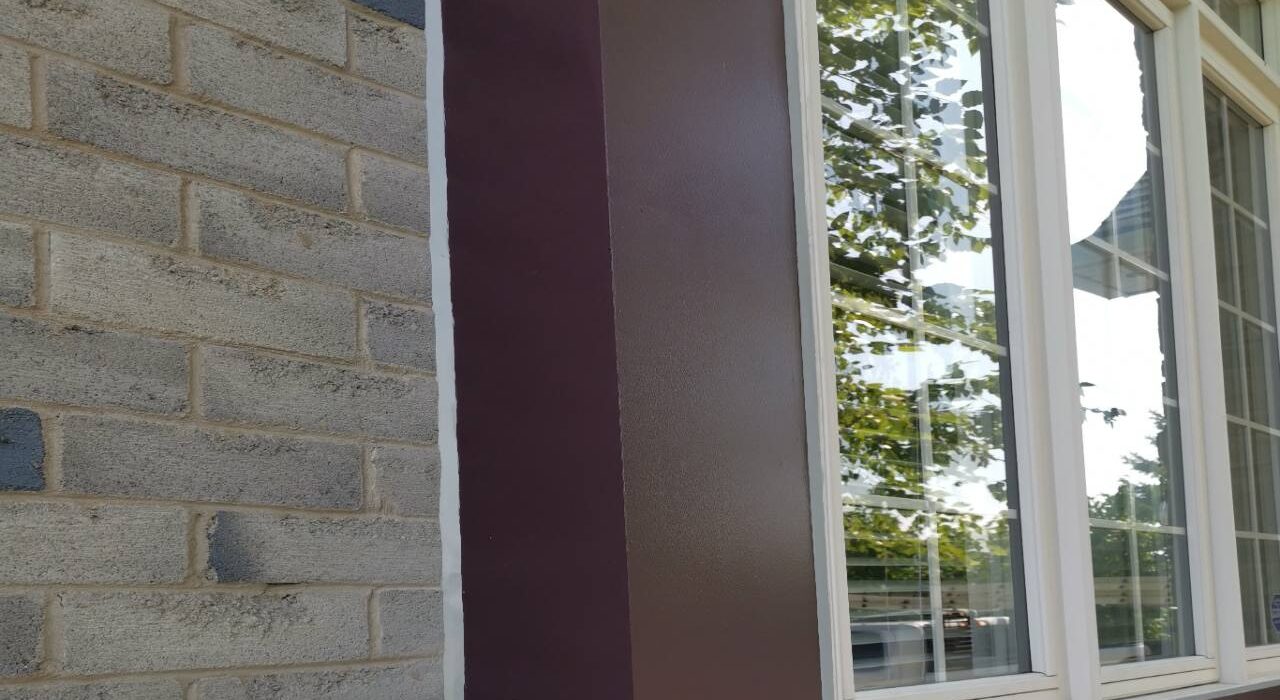
Mastering a proper wood to brick caulking joint is essential because these two substrates expand and contract at completely mismatched rates throughout every Southern Ontario season. A joint that ignores this physical reality is built to fail from the moment the gun is set down.
Treating this hybrid intersection with generic, low-elasticity retail caulk guarantees immediate perimeter tearing during the first significant seasonal weather shift. The bead may look intact for a few months, but the underlying bond is already compromised the moment temperatures swing.
⏱️ Hybrid Sealing Standard
Sealing volatile wood-to-brick transitions requires high-elongation silyl-modified polyethers (commonly called MS-Polymers like Tremco Vulkem 116 or Sonneborn NP1) to safely bridge hygroscopic timber swelling and thermal masonry shifting. To distribute intense multi-axis shear stress evenly, installers must pack compressed closed-cell backer rods to enforce a strict 2:1 width-to-depth joint geometry ratio. Skipping specialized substrate primers like Sika Primer-215 ensures the cured bead will pull away from porous clay brick faces within a single winter freeze-thaw cycle.
PRODUCT SELECTION CHART: COMPARING HOMOGENEOUS VS. HYBRID TRANSITIONS
Different building materials respond uniquely to environmental shifts, making same-material joints much easier to manage than mismatched interfaces. Before selecting an outdoor sealant, field crews must evaluate the specific physical movement traits of both intersecting surfaces.
| Material Interface | Thermal Expansion Rate | Moisture Sensitivity | Primary Stress Vector | Recommended Polymer Base |
|---|---|---|---|---|
| Brick-to-Brick (e.g., rowlock sill joints) | Slow, low coefficient | Low, except at mortar joints | Thermal cycling only | Polyurethane or masonry-grade hybrid |
| Wood-to-Wood (e.g., cedar siding butt joints) | Moderate, varies by grain orientation | High, hygroscopic swelling and shrinkage | Moisture-driven dimensional change | MS-Polymer or premium elastomeric acrylic |
| Wood-to-Brick (hybrid transition) | Severely mismatched between substrates | Extreme differential, one substrate moisture-driven, one thermally driven | Combined shear from two unrelated movement mechanisms | High-elongation polyurethane or MS-Polymer |
The Differential Movement Crash Course
Wood is highly hygroscopic, meaning it absorbs and releases ambient moisture directly from the surrounding air, expanding rapidly whenever humid Lake Ontario air moves through the region. Clay brick, by contrast, responds almost entirely to thermal exposure, expanding slowly and predictably as it heats under direct sun and contracting just as slowly once that heat source is gone.
These two movement mechanisms are not just different in speed, they are triggered by entirely different environmental conditions at entirely different times. A humid but cool day swells the wood while leaving the brick essentially unchanged, and a dry but sun-baked day expands the brick while the wood stays dimensionally stable.
This conflicting seasonal movement exerts intense mechanical shear stress directly along the sealant’s bond line, since the two substrates are rarely moving in the same direction at the same rate.
For a broader understanding of how this same physics problem plays out across other dissimilar material junctions on a building exterior, our complete guide on exterior transition caulking covers the full range of multi-material interfaces.
To analyze the exact mathematical rate at which specific structural building materials deform under climate loads, review the global thermal expansion metrics indexed by the National Research Council Canada Construction Research Centre.
Step-by-Step Joint Preparation Protocol
Managing a hybrid material seam requires an analytical approach to surface cleaning before any fresh compound is injected into the gap. Cutting corners during the early mechanical preparation phases ensures that the volatile boundary will split open during the next seasonal temperature drop.
Mechanical Extraction
Old sealant must be sliced away carefully without gouging the organic wood fibres or grinding down the soft, often historic, brick shoulders found on many Halton Region properties. Our field crews completely eliminate sloppy knife gouging along delicate organic wood casings and soft masonry shoulders.
Instead, we execute precise mechanical joint extraction using specialized, oscillating Fein SuperCut trade frames fitted with ultra-thin flush-cut segment blades, slicing out 100% of failed retail caulk and old tar films down to a completely bare, raw structural substrate track.
A blade held at too aggressive an angle will tear deep into softwood trim casings or permanently chip the edge of an aging clay brick course.
This detailed extraction must remove the weathered bead completely from both adhesion faces, leaving zero residual material that could cross-contaminate the new bond.
Rushing this stage on a hybrid joint is significantly riskier than on a standard single-material joint because both substrates carry completely different structural damage vulnerabilities.
Substrate Priming
Porous brick and organic wood both require a deep vacuum dust wipe followed by specialized substrate priming before any new sealant is applied. Brick pulls migrating oils and mineral salts to its surface over time, while wood naturally exudes resin and tannin compounds that interfere with polymer adhesion if left untreated.
Primer selection must be explicitly compatible with both distinct substrate chemistries simultaneously, which is a more demanding engineering specification than a typical single-material application. Skipping this step on a volatile wood to brick transition is the primary cause of early adhesive-face peeling and delamination along the joint line.
The Two-Point Adhesion Commandment
A closed-cell foam backer rod is completely mandatory in this joint type to establish a correct hourglass cross-section profile and explicitly prevent three-sided adhesion.
Without that flexible backing buffer, the sealant bonds to the back of the building cavity as well as both substrate faces, eliminating its ability to stretch freely when the wood and brick move in opposing directions.
This strict width-to-depth ratio control is even more critical on a hybrid joint than on a homogeneous one because the multi-axis movement direction itself is completely unpredictable from one week to the next.
Our detailed architectural guide on what backer rod is and why it is required for window sealing explains exactly how this geometry is calculated and why it cannot be skipped on any transition joint exceeding standard width tolerances.
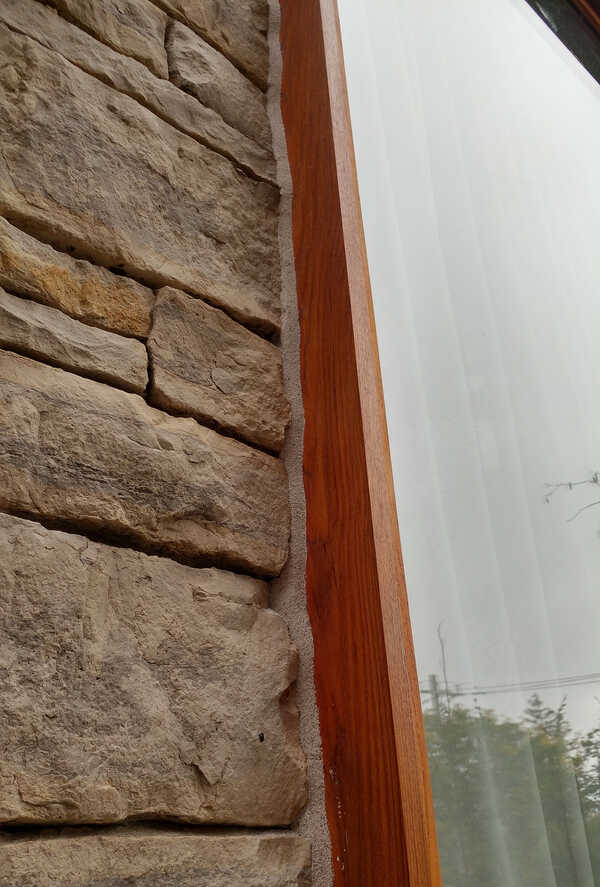
Polymer Selection: Co-Polymers vs. Polyurethanes vs. MS-Polymers
Selecting the correct chemical formulation is the deciding factor in whether a multi-material boundary remains watertight over the long term. Deploying a low-tier compound along a hybrid seam ensures that the sealant bead will rip apart under multi-axis weather loads.
Cheap Acrylic Latex Sealants
Standard cheap acrylic latex sealants are immediately disqualified for any exterior wood to brick caulking application in this climate. Their elongation capacity is far too limited to survive the combined shear stress of two mismatched substrates, and they crack outright during the first hard freeze-thaw cycle along the Niagara Escarpment corridor.
Acrylic formulas cure purely through water evaporation, which causes the material to shrink significantly and lose its flexibility within its first winter. For a complete analysis of how these entry-level retail compounds break down under cold-weather conditions, review our comparison guide on silicone vs polyurethane vs acrylic caulking.
High-Performance Polyurethanes
High-performance polyurethanes offer significantly better elongation metrics and a strong mechanical bond to the porous brick face specifically. Their primary advantage on this joint type is raw tensile strength against the shear forces generated by two substrates moving completely independently of each other.
However, traditional polyurethanes can be highly sensitive to ambient moisture during application and require a prolonged curing window before they can be painted. Contractors should cross-reference these weather limitations against formal trade standards, such as the material specifications maintained by the Canadian Standards Association.
Advanced MS-Polymers
Advanced silyl-modified polyethers, commonly called MS-Polymers, bring an even broader performance profile to this specific architectural application. Our technical crews completely prevent edge separation along resinous cedar or pine trim lines by extruding elite trade formulations like Tremco Vulkem 116, MasterSeal NP1, or Sikaflex-15 LM.
These premium hybrid compounds combine the high elongation capacity needed for the wood substrate’s moisture-driven swelling with the aggressive adhesion required to hold firmly to a porous, irregular brick face.
Because these advanced polymers contain zero volatile solvents, they maintain perfect elasticity through extreme sub-zero temperatures and cure without any acidic byproducts that could etch the masonry or degrade wood fibres. Because they are highly UV-resistant and immediately paintable, they represent the gold standard for sealing volatile multi-material transitions.
Lock in Your Elite Exterior Structural Seal
A wood to brick caulking transition that has never been professionally assessed is one of the most overlooked vulnerabilities on a Halton Region home, quietly accumulating shear damage with every passing season. Reach out to Oleg at Proper Caulking to have your property’s multi-material exterior transitions evaluated by a crew that understands exactly how these two substrates fight against each other.
Our specialized residential remediation crews serve Oakville, Burlington, and Milton with the technical precision this hybrid joint type demands. A proper installation executed with correct backer rod geometry and the right advanced polymer chemistry will outperform a generic retail repair by a decade or more.
Stop Multi-Material Joint Tearing Today
Mismatched expansion rates pull standard caulk apart along your brickwork. Reach out to our exterior transition specialists today to secure your facade with high-elongation hybrid polymers.
Proper Caulking – Oakville, Burlington & Milton, Ontario
Frequently Asked Questions: Wood to Brick Sealing
Do I need to prime both the wood and the brick before sealing a wood to brick joint?
Yes, priming both substrates is mandatory rather than optional on this joint type. Brick surface salts and wood resin compounds each interfere with adhesion differently, and a single universal primer rarely addresses both chemistries adequately.
Can I paint over the sealant once a wood to brick joint is finished?
This depends entirely on the polymer selected. Polyurethane sealants are generally paintable once fully cured, while standard silicone formulas are not, so confirm paintability with your contractor before finishing the surrounding trim.
What is the ideal joint width for a wood to brick transition before backer rod becomes mandatory?
Most professional specifications require backer rod once joint depth exceeds approximately 10 millimetres, though the exact threshold depends on the specific sealant’s recommended depth-to-width ratio. A joint narrower than that may still need backing if it is unusually deep relative to its width.
Why did my wood to brick caulking tear apart within months of installation?
This almost always traces back to either skipping the backer rod, which causes three-sided adhesion failure, or using a low-elongation retail product that physically cannot stretch far enough to accommodate the combined movement of both substrates. Sudden tearing within a single season is rarely a workmanship issue alone; it is typically a specification error.
Does the colour or species of wood affect how the joint should be sealed?
Wood species affects moisture absorption rate and resin content more than colour does, with cedar and other resinous softwoods requiring more attention during the priming stage. Denser hardwood trim moves less dramatically with humidity but still requires the same hybrid-joint backer rod and polymer approach as softer species.